- Neutrality with regard to the distribution of income necessitates a Social Welfare Function that is inversely proportional to each individual's marginal utility of wealth - Brad DeLong, a Non-Sokratic Dialog
- https://doctorow.medium.com/the-memex-method-238c71f2fb46 -Cory Doctorow, The Memex Method
- Deleted Scene from Maggie Stiefvater's Mr. Impossible, from the POV of Adam Parrish https://drive.google.com/file/d/1eEFBlh3JU7S9M40FqlZZZtNJRT_mDP3e/view
- Fourier neural network for solving partial differential equations such as Navier-Stokes. AI has cracked a key mathematical puzzle for understanding our world | MIT Technology Review
Showing posts with label Economics. Show all posts
Showing posts with label Economics. Show all posts
Monday, May 24, 2021
Links for Later, May 24, 2021


Sunday, May 23, 2021
A Non-Sokratic Dialogue with Brad DeLong and Claudia Sahm
From Brad DeLong's substack, originally a Twitter thread started by Claudia Sahm, in which I have a vivid recollection from a 2008 University of Chicago conference where John Cochrane made a keynote speech:
This is your new edition of Grasping Reality—The SubStack Newsletter,
by Brad DeLong: A Non-Socratic Dialogue on the Decline of Milton
Friedman's Influence; & BRIEFLY NOTED: For 2021-05-22 Sa
Things that went whizzing by that I want to
remember...
First:
A Non-Socratic Dialogue:
Milton Friedman’s Influence Kept Right-Wing
Economists from Reverting to Full Crazed Liquidationist Nutjobs for 60 Years.
But Why Did It Then Decline So Fast in the Decade of the 2000s?
Claudia Sahm:
"We should have a
recession,” John H. Cochrane said in November [2008], speaking to
students and investors. “People who spend their lives pounding nails in
Nevada need something else to do.” #yikes <https://t.co/vbSKhIRMtR> by @delong <https://braddelong.substack.com/p/reading-john-lippert-on-the-idiocy> Scott Gosnell: I was
there. I may even have a recording down in the archives and may have sprained
my eyes I rolled them so hard. Brad DeLong: What!
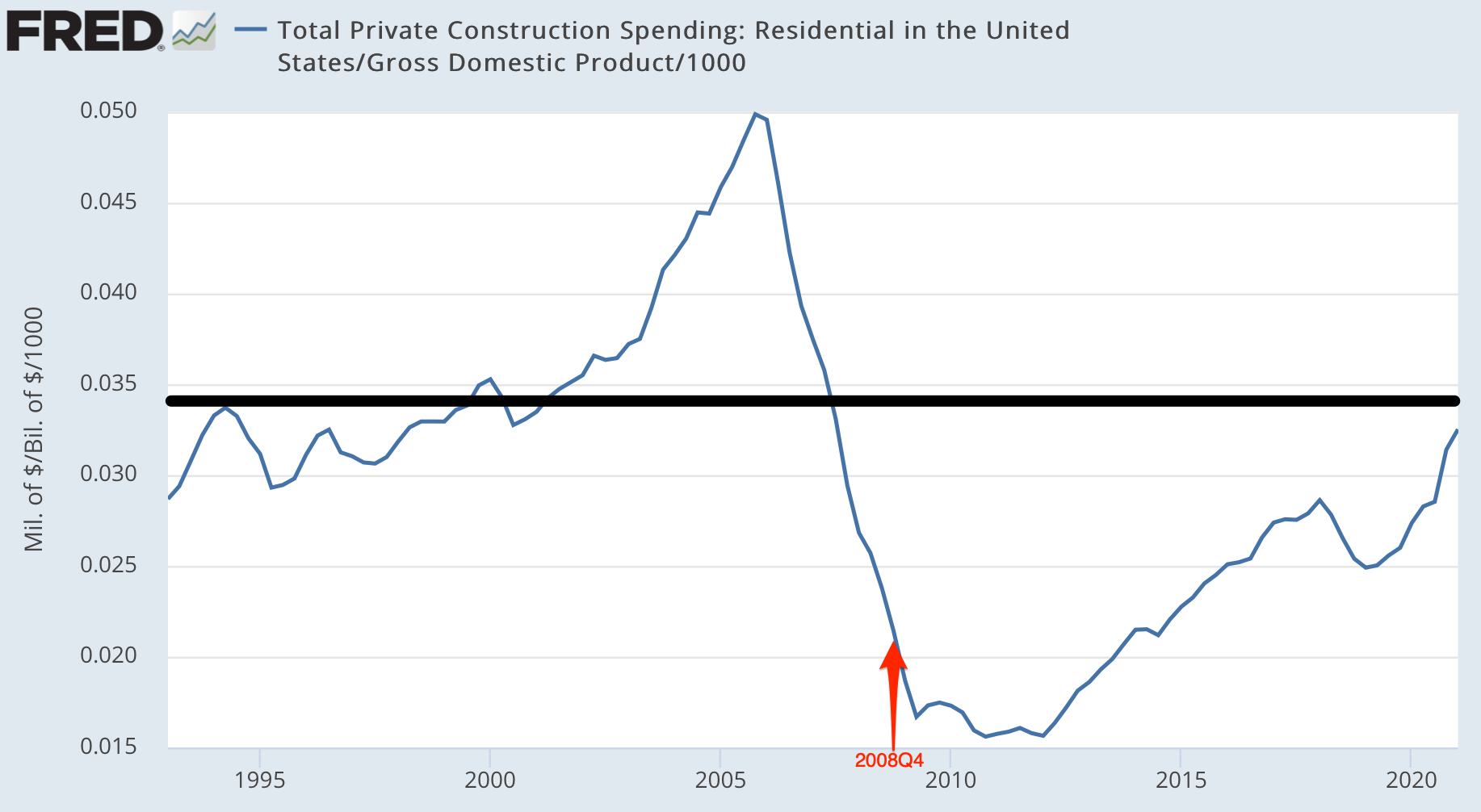
Really? Tell me more… I mean, private housing construction as a share of GDP had crashed
from its peak of 5.0% of GDP in 2005Q4 through its historical average of 3.4%
in 2007Q2, and had bottomed all the way down to 2.1% by 2008Q4, when Cochrane
was opining about too many people pounding nails in Nevada:
How was it possible to say such a thing? How could he
avoid looking at graphs like this one, and noticing that residential
construction employment had already fallen from 150% to 60% of its normal
share even as he spoke? And how did the audience react? Joe Marshall: Holy
hell. What the f—- was wrong with these people? Scott Gosnell: I
went to all of those econ talks at Gleacher while I lived in Chicago. The
noticeable thing about Cochrane was that he was very good at financial
economics, but fell apart when he tried to jump to macro. But of course
faculty could say all kinds of things without getting much skepticism. Being
a Mellon-style liquidationist was sort of edgy and cool among the
Republican-leaning economists at the time. Brad DeLong:
Touché... One question I always ask Paul Krugman and company is: what
happened to the influence of Milton Friedman? No one was a stronger
anti-liquidationist than Milton Friedman.… The shift to
"liquidationism" as the default policy view of a Republican economist
(when Republicans were out of power, at least), seems to have happened
remarkably quickly in one decade, the 2000s, and without analysis and without
argument. How and why did this happen, that being a full-fledged Mellonian
became "edgy" and "cool"? Scott Gosnell: I think
it came swift on the heels of a Randian political moment. Where before,
Austrian economics would get you a glance askance, in 2008, it would get you
a $300+ bottle of wine at dinner with Paul Ryan. Brad DeLong: Touché...
The Hayek-Hoover-Mellon-Marx axis was a remarkable thing among Republican
economists... especially since nobody has ever been able to write down a
coherent overinvestment business-cycle model... Paul Krugman: Hey, I
answered that question at length some years back <https://t.co/MCuyiMwXCg>: Friedman tried
to save free-market economics from itself, admitting that the economy wasn’t
self-correcting but arguing that a rule that didn’t sound Keynesian would let
conservative avoid thinking about that…. But ultimately free-market
Keynesian, even disguised with a monetarist mask, wasn’t sustainable. Jim Beller:
Having his disciples throwing people out of airplanes was a bad look. Brad DeLong: But,
Paul, as you note, Bernanke in 2002 and Mankiw in 2006 still saw Friedman as
“the economist of the century” <https://gregmankiw.blogspot.com/2006/11/milton-friedman.html>
<https://federalreserve.gov/BOARDDOCS/SPEECHES/2002/20021108/>.
They were fine with the “government should not interfere with the economy”
and “whatever is the monetary policy that happens to stabilize aggregate
demand is the true non-interfering ‘neutral’ monetary policy”. It was a con,
yes, but it was a successful con. And it is not clear that it was wrong as a
practical policy position…. JM Keynes (macro)-Henry Simons (antitrust)-AC
Pigou (externalities) is not that far from what you or I believe, or what
Milton Friedman believed—or, at least, would graciously concede in his old
age in outdoor lunch in North Beach if I could get him off of his hobbyhorses
of ‘k% rule’ & ‘government failure is almost always certain to be worse
than market failure.’ The way you put it in your 2013 piece is like this: If markets can go so wrong that they cause Great Depressions,
how can you be a free-market true believer on everything except macro? And as
American conservatism moved ever further right, it had no room for any kind
of interventionism, not even the sterilized, clean-room interventionism of
Friedman’s monetarism”. I think that is (a) right, (b) much too compressed, but (c)
ignores the problem of “where do you stop?” Having the government establish & maintain a
property-rights order & enforce contracts is, after all, a form of
“interference” to the anarcho-capitalists. And while there are some ACs who
want a contract dispute between you and me resolved by me “hiring” my police
force and you “hiring” ours and the two settling the dispute by the Final
Argument of Kings—thus going all the way back to full feudalism as society’s
organizing principle—most do not. Most stop being happy with police &
courts. So why is police & courts acceptable, while police &
courts & demand management is not? I think it has something to do with Schumpeter, von Hayek, and
von Mises; the context of early–20th center Vienna; the idea that humans are
individuals for whom private property and one-shot exchange are “natural” (as
opposed to creatures that establish and cement societal bonds via ongoing
reciprocal gift-exchange relationships); the philosophical position that all
is for the best in this the best of all possible worlds; and the resulting
theological belief that: the market giveth; the market taketh away; blessed be the name
of the market… In short, I think you are right, but I do not understand why
you are right. And here I know I am out of my depth, and I want to call for
people like Emma Rothschild and Glory Liu who are trained professionals to
help here, for they she might be able to teacheth me the lesson… One Video:
Sophie Wilson: The Future of Microprocessors <https://www.youtube.com/watch?v=6lOnpQgn-9s> Very Briefly Noted:
Paragraphs:
Jiwon Choi, Ilyana Kuziemko, Ebonya
Washington, & Gavin Wright: Local Economic and Political Effects
of Trade Deals: Evidence from NAFT: ‘Counties whose 1990
employment depended on industries vulnerable to Mexican import competition
via the 1994 North American Free Trade Agreement (NAFTA) suffer large
employment losses (relative to the bottom quartile of counties, counties in
the top quartile of NAFTA exposure see 5–8 log-point declines in employ- ment
by 2000). Despite large employment losses, we can reject even modest
population declines. Trade-adjustment-aid relief rises, but covers a tiny
share of the job losses we document, and Disability Insurance in fact
displays a much larger response. Exposed counties (many in the upper South)
begin the period more Democratic in terms of votes in House elections, but as
NAFTA is debated in 1992–1994 they shift in the Republican direction and by
2000 vote majority-Republican in House elections. We show with a variety of
microdata, including 1992–1994 respondent-level panel data, that opposition
to free trade predicts shifts towards Republican party identification… Matthew Yglesias: Seventeen Points on Israel &
Palestine : ‘As Joe Biden says, America is an idea…. not an
ethnostate…. The worst moments in our history trace specifically to the
politics of ethnic exclusion…. This is the greatest country on earth…. The
best country Jewish people have ever had in history…. The current iteration
of the Zionist project appeals mostly to believers in ethnic nationalism.
Ethnic nationalism is, as they say, Bad For The Jews…. I am a Jewish American
who likes his cosmopolitan liberalism, thank you very much. I find it
incredibly regrettable that hard nationalism is on the rise globally, and
think that it is leading to pain and misery that will only get worse if it
continues to gain steam…. The Israel-Palestine situation has its own unique
features, but it is also part of a fairly general trend toward hardening
sovereignty claims and deploying nationalism to mask official corruption… LINK: <https://www.slowboring.com/p/israel> Dan Nexon: Against Great Power Competition:
‘Biden underscored his intention to “work with Beijing when it’s in America’s
interests to do so,” but days later noted the likelihood of “extreme
competition” with China…. [Moreover,] Republicans are certain to criticize
the administration for being weak and ineffective in the face of
international challenges…. This is unfortunate. For all the concept’s
influence in recent years, great-power competition is not a coherent
framework for U.S. foreign policy…. Rivalries between leading states exist in
every international system…. With Washington’s unipolar status now on the
wane, powers such as China and Russia find it easier than they once did to
challenge U.S. leadership…. It is one thing, though, for Washington to observe
increasing competition among great powers and adjust to a world in which it
enjoys less influence than it once did. It is another entirely to elevate
competition itself to the guiding paradigm of U.S. foreign policy—as the
Trump administration proposed and Biden may wind up doing…. When adopted as a
foundational paradigm of foreign relations, great-power competition relegates
collaboration to an afterthought or, worse, dismisses it as naive… LINK: <https://www.foreignaffairs.com/articles/united-states/2021-02-15/against-great-power-competition> (Remember: You can subscribe to this… weblog-like newsletter…
here: There’s a free email list.
There’s a paid-subscription list with (at the moment, only a few) extras
too.)
You’re on the free list for Brad DeLong's Grasping Reality. For the full
experience, become a paying subscriber. © 2021 Brad DeLong Unsubscribe
|






Tuesday, March 16, 2021
Why Is Economic Inequality Bad For Society?
ANAND [GIRIDHARADAS]: Should billionaires exist?
DJAFFAR [SCHALCHI]: In a well-regulated, well-managed, and thriving economy without monopolies, they wouldn’t. Wealth is like manure: spread it, and it makes everything grow; pile it up, and it stinks.
(https://the.ink/p/the-american-dream-is-now-in-denmark)
The first problem with gross economic inequality is that it is unjust. Whether you are trying to create a society that offers the greatest good to the greatest number (Utilitarianism), or designing a society such that you would choose to live in it as a member without knowing what your role in that society would be (Rawls), or even just a free society in which we have mutual benefit and self-interest rightly understood (Locke, Mill, et al), we have no reason to favor me over you simply because I have greater wealth, or because of who my parents happen to be, or any other random thing. As it should be with society, so it should be with the markets, which are structures within society.
Now, we might have reasons not to make everyone exactly equal. For example, economic growth tends to be greater when there are incentives for doing economically productive things. The enforcement or transaction costs might be very high. The benefits of corruptly evading these rules of equality would also grow very large.
What’s interesting is that these same costs show up at the other end of the economic distribution scale. If we have an incremental $1000 to incentivize someone to work harder to generate economic goods, we should not send it to a billionaire (who will not notice it), but to someone at the lower end of the income distribution (for whom it will make an enormous difference). If there are a few wealthy oligarchs and a lot of starving serfs, the oligarchs are going to have to hire a lot of guards and police to protect their estates. The Panama Papers showed trillions of wealth funneled through offshore shell corporations to avoid taxes.
The second problem with extreme inequality is that it is inefficient. For the reasons outlined above, it results in worse overall outcomes and in slower growth. In addition, the ability to claim all or even most of the gains to productivity can only result when there is unequal market power. As Schalchi says in the quote above, “ Wealth is like manure: spread it, and it makes everything grow; pile it up, and it stinks.” To have billionaires and paupers in the same society, you must have monopolies/oligopolies/cartels controlling large sectors of the economy, rather than having many small firms that perform slightly better or worse than one another, as in perfect competition or monopolistic competition (variegated production). Monopolies are inherently inefficient, creating deadweight loss by underproducing and overcharging relative to competitive companies. Many monopolies are also monopsonies, underpaying and underbuying labor and other inputs. All of this is just classic free market economics.
Third, the “trickle down” justification for giving tax cuts to the rich and corporations has failed. The LSE study linked below and summarized in the CBS article shows that across the OECD countries, tax cuts for the wealthy have produced zero benefit.
Beginning in 1974 and accelerating in 1980, the relationship between productivity and median household income broke down, coincident with the advent of large tax cuts for the wealthy and the decline of labor power. All of the gains gravitated to the top of the income distribution.
Lower taxes did not produce the boost to growth rates that was promised, or any additional growth at all for most people. The benefit was eaten up by the shareholding class — that’s me, not you.
Looking at the Rand study linked below, you can find out what your income would be, if the United States were only as unequal in 2018 as it was in 1974:
Would you have been better off? Almost certainly. Calculate how much our gross wealth inequality costs your family in particular every year, by looking at that counterfactual column and subtracting your income for 2018.
Would you be better off going forward if we took steps to reverse the concentration of wealth at the very top, by making government policies lift up the average and below? Almost certainly.
So, what’s your argument in favor of the current system and against a more equitable one again?
Rand Study: U.S. Economic Growth Has Not Been Shared Evenly Since 1974
50 years of tax cuts for the rich failed to trickle down, economics study says — CBS News
Working Paper 55 (lse.ac.uk) Economic Consequences of Major Tax Cuts
Sunday, March 07, 2021
Links for Later 3-7-2021
- 50 years of tax cuts for the rich failed to trickle down; the journal article.
ANAND [GIRIDHARADAS]: Should billionaires exist?
DJAFFAR [SCHALCHI]: In a well-regulated, well-managed, and thriving economy without monopolies, they wouldn’t. Wealth is like manure: spread it, and it makes everything grow; pile it up, and it stinks.
Monday, September 10, 2018
Links for Later 9-11-18
- The dye from the murex snail was responsible for both Tyrian purple, used in Imperial robes and tekhelet, the "perfect" blue dye of Hebrew prayer shawls.
- Antitrust legislation rises from the dead, thanks to Lina Khan and others like her.
- Harvard started paying its workers a living wage. Could other companies do the same?
Monday, July 10, 2017
EP 034 Jon Taplin on Internet Monopolies and Creative Culture
Jonathan Taplin is Director Emeritus of the Annenberg Innovation Lab at the University of Southern California. he was a Professor at the USC Annenberg School from 2003-2016. Taplin's areas of specialization are in international communication management and the field of digital media entertainment. Taplin began his entertainment career in 1969 as Tour Manager for Bob Dylan and The Band. In 1973 he produced Martin Scorsese's first feature film, Mean Streets, which was selected for the Cannes Film Festival. Between 1974 and 1996, Taplin produced 26 hours of television documentaries (including The Prize and Cadillac Desert for PBS) and 12 feature films including The Last Waltz, Until The End of the World, Under Fire and To Die For. His films were nominated for Oscar and Golden Globe awards and chosen for The Cannes Film Festival five times. (via jontaplin.com)

Today, Jon talks about his new book, Move Fast and Break Things: How Google, Facebook and Amazon Cornered Culture and Undermined Democracy. It tells the story of how the Internet took a wrong turn from its early days as a source for innovation and wealth for individual creators and entrepreneurs, becoming a highly centralized set of monopolies and oligopolies that suck $50 billion a year in income away from content creators. This has hollowed out whole industries, leaving both producers and consumers less well off both economically and artistically. We discuss some of the history of the Net that led to this point, and some of the possible remedies for the problems we face.


Enjoy this episode, and want me to keep making more?
Subscribe, rate and review it on iTunes.
Want to hear more like it?
Pair with Kevin Kelly's interview. Kevin has a much more positive view of technological change now and in the future.
Subscribe to:
Posts (Atom)