Monday, July 26, 2010


Sunday, July 25, 2010
Stella Gibbons
In the introduction to the Penguin Classics edition of Stella Gibbons' Cold Comfort Farm, Lynne Truss describes Gibbons' father, Telford..."the household was dominated by the violent temper of her father, who drank and womanized, and occasionally threw knives" and apparently liked to threaten to commit suicide. "His own father had been a similarly tyrannical and adulterous paterfamilias: Grandfather Gibbons had even had firearms, and would shoot blank cartridges at the ceiling to quell the noise of his children in the nursery upstairs."
Friday, July 23, 2010
Links for Later
Why your brain is (probably not) a quantum computer, a la Penrose. (via @ycombinator)
She's an artist, he's a poet, now they're married goat farmers with very expensive liberal arts degrees.
Lesser known but cool data structures.
A Russian Sartorialist entry with scythe.
She's an artist, he's a poet, now they're married goat farmers with very expensive liberal arts degrees.
Lesser known but cool data structures.
A Russian Sartorialist entry with scythe.
Thursday, July 22, 2010
"Jesus, this is your line"
The politics behind the Oberammergau Passion Play in the 21st century.
Read the whole article. Not to be missed bits include the tale of Mad King Ludwig and the gift spoons.
"The former pastor asked me to pay him a visit when I became director for the first time," says Stückl. "I had cast a friend as Judas."
The friend was a Protestant.
The priest played various records, with music by Mendelssohn, Bach and Mozart. Which music did Christian like the most, he asked?
Bach, Stückl replied without hesitation. And that's exactly where the problem begins, the pastor replied. Bach, a Protestant, refused salvation. The music of Mendelssohn, a Jew, could offer no salvation. A true Catholic, the pastor said, could only love Mozart. Now that, he said, was the music of salvation.
Read the whole article. Not to be missed bits include the tale of Mad King Ludwig and the gift spoons.
Gormenghast Redux
Rokeby House is a huge 195-year old estate on the Hudson River populated by 10th, 11th and 12th generation descendants of the Astors and Livingstons who built the place. From the Times article:
What a fascinating way to live, in a crumbling house on a vast estate with a rotating cast of relatives from a really, really extened family. It makes me want to write a novel about it, but didn't John Irving already do that?
Photos here.
Not many venture into the vast, shadowy front rooms, which are kept as a shrine to previous generations — a practice that irritates some members of the younger generation — and the French wallpaper is pocked with moisture stains and peeling off in sheets. In the shuttered, paneled Gothic library, Teddy Roosevelt’s photograph sits on a shelf thick with dust (Roosevelt was a pal of great-uncle Wintie Chanler); in a parlor, a bust of Julia Ward Howe, the abolitionist, author of “The Battle Hymn of the Republic” and a great-aunt, is propped on a chipped radiator. A marble plaque in the front hall is “in memoriam” to Stanford White, a family friend, who orchestrated a series of additions to the house in 1894.
Real life occurs in the rabbit warren of kitchens, pantries and servants’ bedrooms, and the small village of outbuildings — barns, cottages and carriage houses — through which family members, friends and tenants career like characters in a French farce.
What a fascinating way to live, in a crumbling house on a vast estate with a rotating cast of relatives from a really, really extened family. It makes me want to write a novel about it, but didn't John Irving already do that?
Photos here.
Wednesday, July 21, 2010
Links for Later
Skidelsky on consolidation vs. stimulus.
Peter Daou: Obama is the most successful failure in a generation
Dennis Hopper interview at Interview
Peter Daou: Obama is the most successful failure in a generation
Dennis Hopper interview at Interview
Illuminatiing
And now, Mike Jay on the birth of the Illuminati. As in the Bavarian ones who are behind all the other conspiracies and whatnot. Makes you wonder, why aren't there any electric cars?
(via boingboing)
(via boingboing)
Tuesday, July 20, 2010
What was Darwin Thinking?
Kamil Ahsan looks at the documentation to figure out Darwin's method as he developed the theory of natural selection. Ahsan's conclusion:
I'm never convinced by these arguments that a particular person only used one mode of thought to get where they needed to go, but the conclusion ultimately reached here is precisely in agreement with that concept--that the search is one guided by both theory and observation.
At some point it must be recognized that evolution by natural selection was not the result of years of observation in which Darwin had no working hypothesis, but instead years of observations geared towards designing proofs for a hypothesis based on little more than a hunch; a frantic search on ‘the species question’ that ensued as little more than a rat race with Alfred Russell Wallace."
I'm never convinced by these arguments that a particular person only used one mode of thought to get where they needed to go, but the conclusion ultimately reached here is precisely in agreement with that concept--that the search is one guided by both theory and observation.
Monday, July 19, 2010
Links for Later
Nassim Taleb on model error
Krugman: the Pundit Delusion
Richard Branson: 5 most important things in entrepreneurship (people, people, people, fun, love)
Krugman: the Pundit Delusion
Richard Branson: 5 most important things in entrepreneurship (people, people, people, fun, love)
UX
It turns out that the Perforated Mexicans were a subset of a larger group of Parisian urban explorers, called UX.
More @ boingboing
In time, the officers’ lights found the PA system. They found the stereo, with guard-dog yowls burned onto a CD. They found three thousand square feet of subterranean galleries, strung with lights, wired for phones, live with pirated electricity. The officers uncovered a bar, lounge, workshop, dining corner, and small screening area. The cinema’s seats had been carved into the stone itself, with room for twenty people to sit in the cool and chomp on popcorn.It is, their spokesman says, about freedom...
On the floor of one cavern, officers discovered an ominous metal container. The object was fat, festooned with wires. The police called in the bomb squad, they evacuated the surface, they asked themselves, What have we found?
They had found a couscous maker.
“We don’t seek out the forbidden,” Kunstmann murmurs over radio-pop. “We just repudiate any notion of authorization.”
More @ boingboing
Liberal Discontent
It appears that liberals haven't been missing the 11-dimensional chess moves of the Obama Administration. They're actually doing what we think they've been doing: screwing up in order to avoid fights with the right. Here's a scalding interview with David Obey, who's had a ringside seat for all of this:
Gosh, what a mess we're in.
The problem for Obama, he wasn’t as lucky as Roosevelt, because when Obama took over we were still in the middle of a free fall. So his Treasury people came in and his other economic people came in and said "Hey, we need a package of $1.4 trillion." We started sending suggestions down to OMB waiting for a call back. After two and a half weeks, we started getting feedback. We put together a package that by then the target had been trimmed to $1.2 trillion. And then [White House Chief of Staff] Rahm Emanuel said to me, "Geez, do you really think we can afford to come in with a package that big, isn’t it going to scare people?" I said, "Rahm, you will need that shock value so that people understand just how serious this problem is." They wanted to hold it to less than $1 trillion. Then [Pennsylvania Senator Arlen] Specter and the two crown princesses from Maine [Sens. Olympia Snowe and Susan Collins] took it down to less than $800 billion. Spread over two and a half years, that’s a hell of a lot of money, but spread over two and a half years in an economy this large, it doesn’t have a lot of fiscal power.
Gosh, what a mess we're in.
Friday, July 16, 2010

Thursday, July 15, 2010

Wednesday, July 14, 2010
Quote of the Day
"Never grow a wishbone, daughter, where your backbone ought to be."
(as seen at boingboing today)
Tuesday, July 13, 2010
Links for Later
Felix Salmon on tail risk strategies, difficulties thereof.
Garry Tan's geographical guide for SF startups. (via @venturehacks)
Brad DeLong on the current and long term deficit outlooks. Remember, PAYGO is your friend.
Garry Tan's geographical guide for SF startups. (via @venturehacks)
Brad DeLong on the current and long term deficit outlooks. Remember, PAYGO is your friend.
Clay Shirky
Russell Davies did his "blog the dog-ears" thing on a set of Clay Shirky interviews, and pulled out a number of gems.
On optimism:
On publishing:
On optimism:
"The final thing I'd say about optimism is this. If we took the loopiest, most moonbeam-addled Californian utopian internet bullshit, and held it up against the most cynical, realpolitik-inflected scepticism, the Californian bullshit would still be a better predictor of the future. Which is to say that, if in 1994 you'd wanted to understand what our lives would be like right now, you'd still be better off reading a single copy of Wired magazine published in that year than all of the sceptical literature published ever since."
On publishing:
"I think someone will make the imprint that bypasses the traditional distribution networks. Right now the big bottleneck is the head buyer at Barnes & Noble. That’s the seawall holding back the flood in publishing. Someone’s going to say, “I can do a business book or a vampire book or a romance novel, whatever, that might sell 60% of the units it would sell if I had full distribution and a multimillion dollar marketing campaign—but I can do it for 1% percent of the cost.” It has already happened a couple of times with specialty books. The moment of tip happens when enough things get joined up to create their own feedback loop, and the feedback loop in publishing changes when someone at Barnes & Noble says: “We can’t afford not to stock this particular book or series from an independent publisher.” It could be on Lulu, or iUniverse, whatever. And, I feel pretty confident saying it’s going to happen in the next five years."
Saturday, July 10, 2010
Fragrance Review: Comme des Garcons Wonderwood
Comme des Garcons built their latest perfume entirely around woody notes. The result is a perfume that feels like the inside of a box at the opera or a Brabus Maybach: tightly crafted, luxurious and polished obsessively smooth.
Luckyscent identifies the following notes: Madagascan pepper, bergamot, Somalian incense, nutmeg, Cristalon, Cashmeran, guaiac wood, cedarwood, caraway seeds, Javanol, sandalwood, vetiver, oud
It's one of the few perfumes I've tried that actually gets louder over time. It begins very light, with a very subtle cedar and then moves into the heart notes dominated by the sandalwood and Cashmeran, coupled with a note like a wooden version of a lemon that is neither citrusy, nor herbal (as lemongrass), nor synthetic (as found in polishes). Late progression turns a little bit nasty (in a cool way) as the oud and patchouli come to the fore.
I tend to like perfumes that have a little more flourish, but this one is undeniably well made. Really strong structure and a smooth progression throughout the entire experience. High marks all around.
Luckyscent identifies the following notes: Madagascan pepper, bergamot, Somalian incense, nutmeg, Cristalon, Cashmeran, guaiac wood, cedarwood, caraway seeds, Javanol, sandalwood, vetiver, oud
It's one of the few perfumes I've tried that actually gets louder over time. It begins very light, with a very subtle cedar and then moves into the heart notes dominated by the sandalwood and Cashmeran, coupled with a note like a wooden version of a lemon that is neither citrusy, nor herbal (as lemongrass), nor synthetic (as found in polishes). Late progression turns a little bit nasty (in a cool way) as the oud and patchouli come to the fore.
I tend to like perfumes that have a little more flourish, but this one is undeniably well made. Really strong structure and a smooth progression throughout the entire experience. High marks all around.
Friday, July 09, 2010
Quote of the Day
"The unreal is more powerful than the real. Because nothing is as perfect as you can imagine it. Because its only intangible ideas, concepts, beliefs, fantasies that last. Stone crumbles. Wood rots. People, well, they die. But things as fragile as a thought, a dream, a legend, they can go on and on. If you can change the way people think. The way they see themselves. The way they see the world. You can change the way people live their lives. That's the only lasting thing you can create."
-Chuck Palahniuk
Thursday, July 08, 2010
Links for Later
David Galbraith on what comes after lofts and suburbs. Possibly posted here before, but search isn't picking it up.
Antibodies that kill 91% of AIDS virus.
Harlan Ellison's reluctant book sale.
"Ultra Batteries" comprised of XeF2, that
Antibodies that kill 91% of AIDS virus.
Harlan Ellison's reluctant book sale.
"Ultra Batteries" comprised of XeF2, that
In its ultra-dense state, the mechanical energy transmitted to the metallized XeF2 is now stored in the substance itself as a kind of chemical energy. All it takes to release it is a perturbation of a single atom in the crystal, which will cause the entire metallized substance to spontaneously "unzip," says Yoo.
The reaction would be, quite literally, explosive. In an instant the XeF2 would turn its stored energy into thermal energy with almost 100% efficiency. The XeF2 stores about 1 kilajoule of energy per gram, or "about 10% of the energy stored in a rocket fuel of liquid H2 and O2 mixtures, or about 20% of [the energy stored in] one of the most powerful explosives, HMX," says Yoo. When viewed as a potential energy storage medium, this discovery qualifies as "a new class of energetic molecules or solid fuels," he adds.
Wednesday, July 07, 2010
Grigua's prayer
"Poor Keynes often sits with me at night after a good dinner and we rail against the world and the coming flood. And I tell him that this is the time for Grigua’s prayer (the Lord to come himself and not to send his Son, as this is not a time for children). And then we laugh, and behind the laughter is [Herbert] Hoover’s horrible picture of thirty million people who must die unless there is some great intervention. But then again we think that things are never really as bad as that; and something will turn up, and the worst will never be. And somehow all these phases of feeling are true and right in some sense..."
-South African politician Jan Christian Smuts on the atmosphere at Versailles
as quoted in Robert Skidelsky, John Maynard Keynes
(via DeLong)
It seems that we are at this point again, or nearly so. When we need more economic stimulus, the austerity crowd seems to be carrying the day. Look for a collapse in the economy this fall if this problem is not rectified. It's time to do a minimum of three things:
- Extend unemployment insurance until unemployment drops to ~5%. Put the unemployment level trigger in the legislation so we don't have to go through this every few months.
- Shove through a jobs bill for teachers, police, firemen and other state workers.
- Keep dumping R&D money into renewable energy
These are the three highest return programs in ARRA, and the economic arguments for doing so are very basic and very clear. In concert with the further fiscal programs, the Fed needs to further expand its monetary policy by any means possible. The pain and austerity crowd must not carry the argument and the day, or we are all in for a world of trouble.
More: Ezra Klein lays out the permutations of stimulus now/balanced budgets later, and finds the Alesina case for austerity to be unconvincing.
Monday, July 05, 2010
Exhausting Art
Snatched from Shalizi's excellent statistical takedown of Martindale's Clockwork Muse, in which it is shown that smoothed white noise can be fitted with a parabolic curve better than Martindale's data.
I quote this because he points to the very same mechanism — demand for novelty plus restrictions of a style leading to certain kinds of elaboration and content — decades before Martindale (Hodgson died, with this part of his book complete, in 1968), and with no pretense that he was making an original argument, as opposed to rehearsing a familiar one.
But there are obvious problems with turning this mechanism into the Universal Scientific Law of Artistic Change, as Martindale wants to do. Or rather problems which should be obvious, many of which were well put by Joseph (Abu Thomas) Levenson in Confucian China and Its Modern Fate:Historians of the arts have sometimes led their subjects out of the world of men into a world of their own, where the principles of change seem interior to the art rather than governed by decisions of the artist. Thus, we have been assured that seventeenth-century Dutch landscape bears no resemblance to Breughel because by the seventeenth century Breughel's tradition of mannerist landscape had been exhausted. Or we are treated to tautologies, according to wich art is "doomed to become moribund" when it "reaches the limit of its idiom", and in "yielding its final flowers" shows that "nothing more can be done with it" — hece the passing of the grand manner of the eighteenth entury in Europe and the romantic movement of the nineteenth.
How do aesthetic valuies really come to be superseded? This sort of thing, purporting to be a revelation of cause, an answer to a question, leaves the question still to be asked. For Chinese painting, well before the middle of the Ch'ing period, with its enshrinement of eclectic virtuosi and connoisseurs, had, by any "internal" criteria, reached the limit of its idiom and yielded its final flowers. And yet the values of the past persisted for generations, and the fear of imitation, the feeling that creativity demanded freshness in the artist's purposes, remained unfamiliar to Chinese minds. Wang Hui was happy to write on a landscape he painted in 1692 that it was a copy of a copy of a Sung original; while his colleague, Yün Shou-p'ing, the flower-painter, was described approvingly by a Chi'ing compiler as having gone back to the "boneless" painting of Hsü Ch'ung-ssu, of the eleventh century, and made his work one with it. (Yün had often, in fact, inscribed "Hsü Ch'ung-ssu boneless flower picture" on his own productions.) And Tsou I-kuei, another flower-painter, committed to finding a traditional sanction for his art, began a treatise with the following apologia:
When the ancients discussed painting they treated landscape in detail but slighted flowering plants. This does not imply a comparison of their merits. Flower painting flourished in the northern Sung, but Hsü [Hsi] and Huang [Ch'üan] could not express themselves theoretically, and therefore their methods were not transmitted.
The lesson taught by this Chinese experience is that an art-form is "exhausted"when its practitioners think it is. And a circular explanation will not hold — they think so not when some hypothetically objective exhaustion occurs in the art itself, but when outer circumstances, beyond the realm of purely aesthetic content, has changed their subjective criteria; otherwise, how account for the varying lengths of time it takes for different publics to leave behind their worked-out forms? [pp. 40–41]
Martindale seems to be completely innocent of such considerations. What he brings to this long-running discussion is, supposedly, quantitative evidence, and skill in its analysis. But this is precisely what he lacks. I have only gone over one of his analyses here, but I claim that the level of incompetence displayed here is actually entirely typical of the rest of the book.
Sunday, July 04, 2010
Happy Fourth
That's Americana.
Got a big dog? You're in the parade.
Got an old car? You're in the parade.
Dressed up funny? Part of a group?
Have a talent? Just outgoing? You're in.
The only bad parades are the ones right after a war starts, when the drumbeat's still going, and the price is still in the future.
This one was one of the nice ones, on the best day of the year to be in Upper Arlington.


Got a big dog? You're in the parade.
Got an old car? You're in the parade.
Dressed up funny? Part of a group?
Have a talent? Just outgoing? You're in.
The only bad parades are the ones right after a war starts, when the drumbeat's still going, and the price is still in the future.
This one was one of the nice ones, on the best day of the year to be in Upper Arlington.


Hot Koalas
Sent to me by a reader: "At 120 degrees in Australia, it was so hot... that koalas were asking people for water. It's never been seen before." From last summer (January 2009)






Thursday, July 01, 2010
Why Austerity Will Strangle Growth
Here's a breakdown by the Dallas Fed of the drivers of the current recovery. Inventory adjustments represent an unusually large proportion of the total improvement, and now end sales are catching up with the reduced inventory backlog. As Mark Thoma notes:
Given this worrisome short-run outlook for GDP growth, and hence for employment, why do some people think cutting stimulus, which is what cuts to the deficit do, is the way to enhance the recovery?
Output can be written as Y = C + I + G + NX (output = consumption + investment + government spending + net exports). If we cut the deficit through reductions in spending and increases in taxes, we know G will go down (as spending falls) and that C and I will also fall (from tax increases on consumers and businesses). But somehow, the story goes, as GDP and employment are falling, confidence will go up so much that C, I, and perhaps NX will go up more than enough to compensate for the fall, and then some. However, if the confidence effect doesn't appear and generate very strong effects, and it's unlikely that it will despite the wishful thinking from some, deficit reduction makes things worse in the short-run, not better.
Wednesday, June 30, 2010
Links for Later
Why no GARCH in Basel III? 'Cause GARCH blew up, and now nobody knows what to use.
Passing or coming out? bi guys
Paul Krugman: Learned Helplessness in Macro, or Why Zombie Theories are Back
Bruce Sterling on Anna Chapman, web 2.0 user and alleged Russian spy.
Passing or coming out? bi guys
Paul Krugman: Learned Helplessness in Macro, or Why Zombie Theories are Back
Bruce Sterling on Anna Chapman, web 2.0 user and alleged Russian spy.
Tuesday, June 29, 2010
The Two Children Problem Reconsidered
People have threatened to punch me for bringing up the Monty Hall Problem at parties, despite the fact that the people I brought it up to were quants (who presumably enjoy such things), and despite the fact that I don't otherwise make people do party games. I feed them, I talk with them, but I don't make them play Pictionary, 'cause that's just mean.
In the mean time, here's another troublesome problem, the Two Children Problem, posed by Gary Foshee
In the mean time, here's another troublesome problem, the Two Children Problem, posed by Gary Foshee
Gary Foshee, a collector and designer of puzzles from Issaquah near Seattle walked to the lectern to present his talk. It consisted of the following three sentences: "I have two children. One is a boy born on a Tuesday. What is the probability I have two boys?"Now, the answer we arrive at might be any of the following: 1/2, 1/3, or 13/27, depending on the method used to arrive at the answer. But what actually determines the correct answer is why you told us about the boy being born on Tuesday.
So why does intuition seem to lead us so astray? Both the intuitive and the mathematically informed guesses are wrong. Are human brains just badly wired for computing probabilities?
Not so fast, says probabilist Yuval Peres of Microsoft Research. That naïve answer of 1/2? In real life, he says, that will usually be the most reasonable one.
Everything depends, he points out, on why I decided to tell you about the Tuesday-birthday-boy. If I specifically selected him because he was a boy born on Tuesday (and if I would have kept quiet had neither of my children qualified), then the 13/27 probability is correct. But if I randomly chose one of my two children to describe and then reported the child’s sex and birthday, and he just happened to be a boy born on Tuesday, then intuition prevails: The probability that the other child will be a boy will indeed be 1/2. The child’s sex and birthday are just information offered after the selection is made, which doesn’t affect the probability in the slightest.
...Peres says that we shouldn’t despair about our probabilistic intuition, as long as we apply it to familiar situations. The difficulty of these problems is rooted in their artificiality: In real life, we almost always know why the information was selected, whereas these problems have been devised to eliminate that knowledge. “The intuition develops,” he points out, “to handle situations that actually occur.”
Thomas Edison's To-Do List
When I was in third grade, I wrote a spectacular paper on Thomas Edison that got an A, becoming the foundation of much later scholarship, if I may say so. My father refers to this paper (and everything else I write) as "Thomas Edison and His Toads and Frogs", or occasionally as "Black Holes, Toads, Frogs, Thomas Edison, and What I Did for Summer Vacation". Thanks, Dad.
Below, you can see one of Mr. Edison's to-do lists for January 3rd, 1888. List items include "Deaf Apparatus", "Electrical Piano" and "Ink for Blind". The list goes on for a number of pages—I was
initially concerned that this was the list for the day, but another subsequent list appears in the same book for April of that year, so I assume he got through the several hundred inventions in about three months, a comparatively leisurely pace. This particular page is also notable for the legible handwriting, which declines as we move through the notebook; it's a relief that old Thomas Alva may have been a workaholic genius, but also had poor penmanship.

Below, you can see one of Mr. Edison's to-do lists for January 3rd, 1888. List items include "Deaf Apparatus", "Electrical Piano" and "Ink for Blind". The list goes on for a number of pages—I was
initially concerned that this was the list for the day, but another subsequent list appears in the same book for April of that year, so I assume he got through the several hundred inventions in about three months, a comparatively leisurely pace. This particular page is also notable for the legible handwriting, which declines as we move through the notebook; it's a relief that old Thomas Alva may have been a workaholic genius, but also had poor penmanship.

image from the Rutgers collection of Thomas Edison's papers
Click to embiggen.
Monday, June 28, 2010
Links for Later
Photos of waves from underneath (via rcs)
The Girl Who Fixed the Umlaut
Messrs Malthus, Say and Mill on Keynesian Economics (or not)
The big Chinese genomics mill
The Girl Who Fixed the Umlaut
Messrs Malthus, Say and Mill on Keynesian Economics (or not)
The big Chinese genomics mill
Saturday, June 26, 2010
RIP Tobias Wong
Designer and artist Tobias Wong hanged himself last month, possibly while sleepwalking. There was no suicide note, no sign of depression, rather an upswing in his career and personal life.
He was best known for his "paraconceptual" art pieces, like the silver cold pills:
He was best known for his "paraconceptual" art pieces, like the silver cold pills:
Allan Chochinov, the editor in chief of Core 77, a design Web site, remembered the first time he met Mr. Wong. It was the late ’90s, and he was walking down Prince Street when he ran across the boyish designer standing next to a folding table selling capsules — the sort cold medicine comes in — filled with silver leaf.The New York Times article is fascinating.
“I picked one up and said, ‘So you eat these?’ He was like, ‘uh huh.’ ‘And it turns your poop silver?’ And he said, ‘yep.’ ” Mr. Chochinov recalled.
Friday, June 25, 2010
Quote of the Day
On the point
What is the point. That is what must be borne in mind. Sometimes the point is really who wants what. Sometimes the point is what is right or kind. Sometimes the point is a momentum, a fact, a quality, a voice, an intimation, a thing said or unsaid. Sometimes it’s who’s at fault, or what will happen if you do not move at once. The point changes and goes out. You cannot be forever watching for the point, or you lose the simplest thing: being a major character in your own life.
—Renata Adler, “Brownstone”
What is the point. That is what must be borne in mind. Sometimes the point is really who wants what. Sometimes the point is what is right or kind. Sometimes the point is a momentum, a fact, a quality, a voice, an intimation, a thing said or unsaid. Sometimes it’s who’s at fault, or what will happen if you do not move at once. The point changes and goes out. You cannot be forever watching for the point, or you lose the simplest thing: being a major character in your own life.
—Renata Adler, “Brownstone”
Thursday, June 24, 2010
Links for Later
Anosognostic, Part 2
Victor Niederhoffer is a very bright, very nice guy who blew up his hedge fund, twice. Here, he talks with Kathryn Schulz about error, and why one doesn't see one's own mistakes:
Niederhoffer's e-mails suggested a man already obsessed with wrongness. In them, he referenced the statistical concept of path dependence; shared a series of proverbs about the game of checkers (of 5,000 such proverbs, he hazarded, about 250 concerned error); meditated on the difference between Type One mistakes (excessive credulity) and Type Two mistakes (excessive skepticism) (he himself is much more prone to Type One, he says: "I'm tremendously gullible"); observed that "one should be careful of multitasking or multiromancing"; sent me the citations for hoodoo in the Oxford English Dictionary (a hoodoo is something or someone that brings bad luck); and noted that the harpooner in Moby Dick would have made a great interview subject for this series. Finally, he pointed out that the word error has no antonym. "In retrospect," he wrote, "I know much too much about errors and much too little about the opposite, whatever it is."The best bits of the interview include the insight that he played squash too perfectly (and safely), while playing the market without enough safety, advice on avoiding "hoodoos" (people who will bring you bad luck sooner or later), and "taking out the canes":
When the public is most frightened, only the strong are left, and that's when the market is in the best possible hands. I call it taking out the canes. Whenever disaster strikes, the very sagacious wealthy people take their canes, and they hobble down from their stately mansions on Fifth Avenue, and they buy stocks to the extent of their bank balances, and then a week or two later, the market rises, they deposit the overplus in their accounts, invest it in blue-chip real estate, and retire back to their stately mansions. That's probably the best way of making money, to be a specialist in panics. Whenever there's panic hanging in the air, that's a great time to invest.
Anosognosic
This five part series of interviews by Errol Morris deals with the fact that we believe we know more than we do, are self-deceptive, confabulate, and generally get things wrong. This set of articles could make a fine book all by themselves. Neuroscientists, biographers, Donald Rumsfeld and Woodrow Wilson make appearances, alongside a very confused bank robber:
Wheeler had walked into two Pittsburgh banks and attempted to rob them in broad daylight. What made the case peculiar is that he made no visible attempt at disguise. The surveillance tapes were key to his arrest. There he is with a gun, standing in front of a teller demanding money. Yet, when arrested, Wheeler was completely disbelieving. “But I wore the juice,” he said. Apparently, he was under the deeply misguided impression that rubbing one’s face with lemon juice rendered it invisible to video cameras.It's a phenomenon that affects both the fool and the genius. We don't notice when we're screwing up. The best answer I've heard for why this is the case is that if we were realistic about our knowledge and capabilities, we'd never do anything.
The Endless Game
Today, John Isner and Nicolas Mahut will resume playing the longest match in the history of tennis, after reaching a score of 59-59 in the fifth set before nightfall yesterday.
(via tr)
Update: Isner wins 70-68 in the 5th, two days after the match began.
John Isner of Tampa, Fla., and Nicolas Mahut of France were tied at 59-59 in the fifth set at Wimbledon after exactly 10 hours of action when play was suspended because of darkness Wednesday night. It is by far the longest match in terms of games or time in the century-plus history of tennis...The 23rd-seeded Isner and the 148th-ranked Mahut, who needed to qualify to get into the tournament, shared a court for 7 hours, 6 minutes in Wednesday’s fifth set alone, enough to break the full-match record of 6:33, set at the 2004 French Open. Never before in the history of Wimbledon, which first was contested in 1877, had any match — singles or doubles, men or women — lasted more than 112 games, a mark set in 1969. Isner and Mahut played more games than that in just the fifth set, and still did not determine a victor, although the American came close: He had four match points — four chances to end things by winning the next point — but Mahut saved each one.
(via tr)
Update: Isner wins 70-68 in the 5th, two days after the match began.

Update: check out this commentator

Sunday, June 20, 2010
Links for Later
Rajiv Sethi on Minsky's evolutionary perspective on market instability. Additional information.
Paul Krugman: "the facts have a well-known Keynesian bias".
Steve Waldman: "Austerity is stupid..."
Bryan Caplan on trembling hand perfectionism.
Paul Krugman: "the facts have a well-known Keynesian bias".
Steve Waldman: "Austerity is stupid..."
Bryan Caplan on trembling hand perfectionism.
Friday, June 18, 2010
RIP Sebastian Horsley
It seems that the heroin finally caught up with Sebastian. Based on the comments of those who knew him (or just encountered him), it seems he was a very nice man who went to great lengths to make others believe that he was terrible.
 Photo credit: Steve Forrest
Aerator
For those of you who want to get me something for Christmas, may I suggest this preposterous piece of wine apparatus?
Wednesday, June 16, 2010
The Indiana Jones of Interior Decorating
For when you absolutely have to have that Indonesian temple roof, send one of these guys:
Keenen Ivory Wayans, Mr. Finton said, once told him, “One day we’re going to see you on one of those CNN things, blindfolded and saying, ‘I’m just here for the limestone.’ ”
Tuesday, June 15, 2010
Oil Spill Humor
I'm surprised no one has resurrected this classic bit yet: "The Front Fell Off". Only marginally sillier than the real thing.
Monday, June 14, 2010
The Quotable DeLong on Appropriate Macro Policy
The only thing that you needed to know to understand the Principles of Animalism in Animal Farm was "four legs good, two legs bad"[1].
Similarly, the only thing you needed to know to understand the macroeconomic policy line of the Obama administration--or, rather, what the macroeconomic policy line should be--is "short-run deficit spending to speed short-term recovery, long-run budget balance to enable long-term growth."
That is the right economic policy for the country.
Similarly, the only thing you needed to know to understand the macroeconomic policy line of the Obama administration--or, rather, what the macroeconomic policy line should be--is "short-run deficit spending to speed short-term recovery, long-run budget balance to enable long-term growth."
That is the right economic policy for the country.
Sunday, June 13, 2010
Where Fun Goes to Die
Those crazy kids down at the BRS alma mater University of Chicago have resurrected latin-named, R rated magazine Vita Exlocatur, featuring what used to be called artistic pictures of undergrads and friends. Hot nerd alert!
Saturday, June 12, 2010
Wikileaks
The whole Wikileaks/Bradley Manning/Julian Assange imbroglio is reaching a state of high fluidity. Manning is under arrest, Wikileaks founder Julian Assange is playing hide-and-seek with Pentagon assets, and may be in danger of "extreme sanctions" (or other John Le Carre-esque euphemisms), if Daniel "Pentagon Papers" is to be believed.
He's also trying to get his hands on the transcripts Adrian Lamo turned over to the feds, before the feds are able to prevent the release of a large number of leaked diplomatic cables.
Expect to see more in the headlines over the coming weeks, and in the meantime, have a look at this New Yorker profile of Assange, who seems to have had the kind of life where this week's troubles are par for the course. Hiding from cultists, safe houses in Reykjavik and motorcycling through Vietnam feature prominently.
I could swear I met him online in the 80's when he went by the handle Mendax...or maybe I should swear I've never heard of him.
He's also trying to get his hands on the transcripts Adrian Lamo turned over to the feds, before the feds are able to prevent the release of a large number of leaked diplomatic cables.
Expect to see more in the headlines over the coming weeks, and in the meantime, have a look at this New Yorker profile of Assange, who seems to have had the kind of life where this week's troubles are par for the course. Hiding from cultists, safe houses in Reykjavik and motorcycling through Vietnam feature prominently.
I could swear I met him online in the 80's when he went by the handle Mendax...or maybe I should swear I've never heard of him.
Friday, June 11, 2010
Thursday, June 10, 2010

Andrei Tarkovsky's Polaroids
Bottlerocketscience has a fondness for the real-time quality of Polaroids, and this sampling of Russian director Andrei Tarkovsky from a Russian language photoblog shows exactly what can be done in the medium. Lyrical, haunting, and still immediate decades later.


Wednesday, June 09, 2010
Douglas Adams on Tail Risk
The major difference between a thing that might go wrong and a thing that cannot possibly go wrong is that when a thing that cannot possibly go wrong goes wrong it usually turns out to be impossible to get at or repair.(via Mark Thoma, via Paul Kedrosky, via Ezra Klein)
Prince Poppycock
The Coilhouse folks have taste, and they like Prince Poppycock (aka John Quale), therefore you and the rest of America will bow before the oncoming storm, as he performs on America's Got Talent. I can barely wait until the inevitable Poppycock/Gaga duet.
Perfume Gardens
Nice article about people formulating perfumes from their own gardens. Makes me want to grow a Chinese perfume tree and boil it up with some jojoba oil.
Tuesday, June 08, 2010
Links for Later
Entoptic Forms: the way the embedded patterns of the visual nervous system inform paleolithic art.
Combing the countryside: expanding acceptance of racial types of Brazilian models.
Whatever, Dude: expanding acceptance of gays & lesbians among American men.
Barry Ritholtz takes down Art Laffer on the coming apocalypse over the Bush tax cuts sunset.
Combing the countryside: expanding acceptance of racial types of Brazilian models.
Whatever, Dude: expanding acceptance of gays & lesbians among American men.
Barry Ritholtz takes down Art Laffer on the coming apocalypse over the Bush tax cuts sunset.
William Gibson's Book Expo Talk
The capital F Future "is gone":
Say it’s midway through the final year of the first decade of the 21st Century. Say that, last week, two things happened: scientists in China announced successful quantum teleportation over a distance of ten miles, while other scientists, in Maryland, announced the creation of an artificial, self-replicating genome. In this particular version of the 21st Century, which happens to be the one you’re living in, neither of these stories attracted a very great deal of attention.Also worth reading for his explanation of his previous books, which are about, no surprise, the decades in which they were written.
Life on Titan?
Two new papers have come out, suggesing that there could be life on Titan that "breathes hydrogen, eats acetylene and excretes methylene". But, as Maggie Korth-Baker puts it on boingboing:
let's knock out one basic thing right off the bat: Nobody has discovered alien life. We have not found E.T. This is only a test of the emergency high-pitched happy squealing system.
That said, it probably wouldn't be remiss to clap your hands delightedly, like a little girl. As I said, nobody has found alien life, but they did find the sort of evidence that might suggest alien life is down there on the surface of Titan, waiting to be found. It's a little like walking up to a house and finding the front door open, and, inside, a T.V. stand that's missing a T.V. It's reasonable to assume the house might have been burglarized, but there are also other plausible explanations and you don't have enough evidence to know one way or the other.
Saturday, June 05, 2010
Michaelangelo, Neuroanatomist
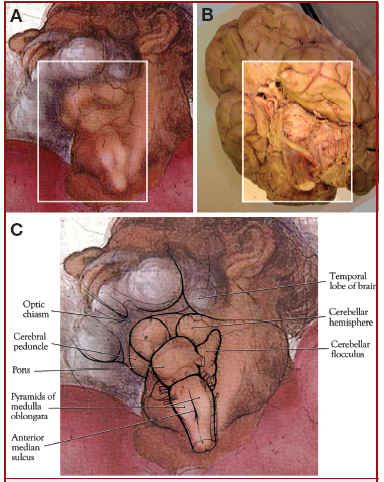
More evidence that Michaelangelo hid detailed anatomical depictions of neuroanatomy in the Sistine Chapel ceiling. Cheeky devil, that Mike.
Kinder Than Necessary
"Be kinder than necessary, for everyone you meet is fighting some kind of battle."
=James M. Barrie + Plato
Above, a portmanteau of a quote, said to be jointly developed from statements of the two distinguished gentlemen, according to a post in a discussion of the various kindnesses delivered by Mr. Keanu Reeves, "struggling musician", post-modern Messiah of several alternate timestreams and genuinely nice guy.
Images of the Week
 Dennis Hopper, "Double Standard".
  Harold Edgerton, "Stonehenge at Night" (1944). via BLDGBLOG
 Unknown, "What the devil's for dinner?", via Design Observer
 Gulf Pelicans in Oil, Telegraph.
 Michael Chung, "Stare Game", Pictory showcases New York.

Friday, June 04, 2010
Funny Looking
Yesterday, in the course of a quarter mile trip to return some videos to the library, no less than five people gave me looks of the kind of profound disgust you might give to someone with feces smeared on their face. It got to the point where I checked myself in the mirror--no feces. Checked the car for kittens stapled to the front fender--no kittens.
I'm stumped.
I'm stumped.
Tuesday, June 01, 2010
Links for Later
Keynesian Porn
John Underkoffer demonstrates Minority Report-style user interface.
Joshua Davis does some generative art about the BMW Z4.
John Underkoffer demonstrates Minority Report-style user interface.
Joshua Davis does some generative art about the BMW Z4.
Monday, May 31, 2010
Tuesday, May 25, 2010
Monday, May 24, 2010
Dopamine as the Gateway to Working Memory
Zachary Burt, in a blog post on the Neuroscience of Buddhism:
via @ycombinator
it explained how dopamine is a gateway to the regulation of working memory. When dopamine levels are steady, the “doorway” of working memory is closed; when they are low, the “doorway” opens, when there is a spike, the “doorway” opens. Why is this?
When you are feeling bad, (low dopamine), your attention is scattered so you can find things in the environment that will spike your mood: you are going to be more likely to be able to find food, sight potential mates, etc. When there is a spike in dopamine, you need to open your attention to be alert to the new threat/opportunity. Otherwise you can let the contents of your working memory remain constant so you can work on whatever problems are currently on your mind.
via @ycombinator
Saturday, May 22, 2010
Friday, May 21, 2010
On the Limits of Economic Justice
This week in economic justice:
Rand Paul falls into the error of unconstrained libertarianism.
Marginal Revolution on the limits of Benthamite utilitarianism.
In conversation: "We are wiser perhaps for worshipping at the altars of many small gods."
Rand Paul falls into the error of unconstrained libertarianism.
Marginal Revolution on the limits of Benthamite utilitarianism.
In conversation: "We are wiser perhaps for worshipping at the altars of many small gods."
Thursday, May 20, 2010
The Future Is Now, Vol. LXXXI: Synthetic Life
Craig Venter and friends just announced the continuous replication of a lifeform with a completely synthetic genome. In short, new life. This is a big one.
Caveat: existing cells are still required to house the novel genome.
For now, Igor, for now...
Caveat: existing cells are still required to house the novel genome.
For now, Igor, for now...
Wednesday, May 19, 2010
Quote(s) of the Day
Man is but a reed, the most feeble thing in nature; but he is a thinking reed. The entire universe need not arm itself in order to crush him; a vapor, a drop of water, suffices to kill him. But when the universe crushes him, man is still more noble than that which kills him, because he knows that he is dying and the advantage that the universe has over him; the universe knows nothing of of this.
-Blaise Pascal
Some people say, In this big universe, you're just a speck of dust.
You may be a speck of dust.
But oh, what a speck of dust.
In this speck of dust, the infinite and the finite are fused.
And you are the threshold of the two.
Here, the mortal being comes as close
as it possibly can to the immortal.
The same power that drives the universe breathes us.
We have been chosen to be the platform for life.
-Prem Rawat
(via Andrew & his readers)
Tuesday, May 18, 2010
It was a Very Good Year
Lone Gunman, one of the best blogs for business thinking on the web, reviews its second year. Lots of good stuff.
Monday, May 17, 2010
Stalker
BLDG BLOG's meditation on the "ghosts of the future", or how Roadside Picnic, later made into the film Stalker, prefigured the deadlylandscape around Chernobyl.
Friday, May 14, 2010
Ghost Messages
On the heels of the strangest sentence of the week, someone has been leaving mid-paragraph rants on my answering machine. One of these is replicated for you here by way of example:
Is this someone's cellphone dialing me by accident? A message from beyond the grave? What?
"...San Francisco, or some of them other places. Yes, it's transferable. He's
been talking about that for a while. Yes, I'm sure that's true. Manageable. Only the finest cuts..."
Is this someone's cellphone dialing me by accident? A message from beyond the grave? What?
Thursday, May 13, 2010
Strangest Sentence I've Uttered All Week
"I cannot recommend that you slap your customer's vagina after giving her a Brazilian."

Structured Finance Explained
Alex Tabarrok writes a pretty good explanation of how CDOs restructure risk.
As he mentions in his post, models which underestimate the expected default rate will blow up the structure. I should also mention that underrepresenting the correlation among assets will likewise result in a structure that's prone to blow up, and that beyond a certain point, all correlations will move toward 1, meaning that the failure of enough mortgages in a pool will make it almost certain that the other mortgages will fail and that your model will have underestimated this fact.
In the recent meltdown, both of these things happened: the chances that the underlying mortgages would independently fail increased and the correlation among all of the mortgages increased. Moreover, there were a number of CDOs out there that appear to have been filled with lemons, where the odds of the underlying failing were known to be higher by the seller, but not the buyer.
As he mentions in his post, models which underestimate the expected default rate will blow up the structure. I should also mention that underrepresenting the correlation among assets will likewise result in a structure that's prone to blow up, and that beyond a certain point, all correlations will move toward 1, meaning that the failure of enough mortgages in a pool will make it almost certain that the other mortgages will fail and that your model will have underestimated this fact.
In the recent meltdown, both of these things happened: the chances that the underlying mortgages would independently fail increased and the correlation among all of the mortgages increased. Moreover, there were a number of CDOs out there that appear to have been filled with lemons, where the odds of the underlying failing were known to be higher by the seller, but not the buyer.
Wednesday, May 12, 2010
Bret Easton Ellis Interview
Bret Easton Ellis talks to Vice about the ominous atmosphere in LA, why he's not Patrick Bateman or any of his other characters (despite the frequent confusion by his readers), his forthcoming novel Imperial Bedrooms and his screenplay The Golden Suicides, "about the lives and deaths of the artists Jeremy Blake and Theresa Duncan."
Having not known them, I could only guess. Maybe there was a mutual feeding of each other’s paranoia?
There was the paranoia. And I mean, I think she needed a narrative. She needed an explanation as to why she wasn’t making it in Hollywood. She’d made it before, in the video-game world, but I think she came out here and everyone expected her to be a star, this big moviemaker, and she didn’t realize that movies just aren’t getting made. It drove her crazy, and she couldn’t accept that defeat and so she had to build this narrative.
That’s where her theories about a Scientologist plot against her come into it.
The Scientologists. And then she began to build this huge narrative as to why she wasn’t successful in the film industry. I’m haunted by it. I don’t know why it resonated with me so much.
You explained it pretty well. It was the relationship that you’d been having, and your experience with The Informers. That could really put you in a place where the Blake-Duncan story would hit you hard.
And they were hot.
They were hot. Yeah.
Literally, this is how it sold with one of the producers, to get financing for it. “Who wants to see a movie about two people who kill themselves?” And then the other producer said, “Well, they were hot.”
Oh, fuck.
And he said, “Really? Well, where’s the pictures of them? Ah. Yeah.”
This was two producers talking to each other?
Yeah.
Monday, May 10, 2010


Sunday, May 09, 2010
Links for Later
Saras Sarasvathy's theory of effectual reasoning & entrepreneurship.
Pogo: "Gardyn," a song for Mother's Day
Pogo: "Gardyn," a song for Mother's Day
Friday, May 07, 2010
Birth of a Spartan
Bungie's new trailer for Halo Reach deals with the ambivalence of becoming a cyborg in the game's increasingly grim meathook future.
Thursday, May 06, 2010
The Obscene Supreme Court on Obscenity
De Onion kix az:
"I'm beginning to wonder if you really understand what 'abridging the freedom of speech' means at all," said Stevens, a 34-year veteran of the court known for his often-nuanced interpretations of the First Amendment. "I'm also wondering whether you and your fat-faced plaintiffs over there need to have some respect for constitutionally protected expression fucked into your empty hick skulls."(via jwz)
Wednesday, May 05, 2010
Tuesday, May 04, 2010
Baige and Other xkcd Viewer-Identified Colors

Xkcd did a reader survey of display colors, with some interesting results from some interesting people. New color names included "baige"[sic] (popular among guys), "what I'm sure was once nice wallpaper before you stained it with your nicotine" and "gosh, thats blue".
Monday, May 03, 2010

Sunday, May 02, 2010
Subscribe to:
Posts (Atom)