For a minor campaign stop, Obama draws a crowd three times the size of Sarah Palin's home town. Twice the size of the crowd McCain was able to muster for his VP announcement. I wonder what that tells us.
Saturday, August 30, 2008
Obama rally Dublin, OH
For a minor campaign stop, Obama draws a crowd three times the size of Sarah Palin's home town. Twice the size of the crowd McCain was able to muster for his VP announcement. I wonder what that tells us.


Friday, August 29, 2008
The Promise of America
"Enough!"
"We are better than these last eight years."
Barack Obama delivered a perfect speech last night. He accomplished everything he needed to do. I think we can safely say that the party is unified, and the Independents are by and large persuaded.
The Fox News guys looked snakebit, and could only describe the speech as "pedestrian, more prose than poetry." Hah. Watch it and weep.
Wednesday, August 27, 2008
Card Trick
For the second time in about a month, I've woken out of a dream that would make a great short story. This time, an elaborate mystery story about a pack of cards, a city-wide amateur manhunt, and a chemical peel. Ricky Jay and Keith Olberman are featured.
This sort of thing may not get you something real, but the rule is, if it was good enough to wake you up, it's good enough to write down.
This sort of thing may not get you something real, but the rule is, if it was good enough to wake you up, it's good enough to write down.
Tuesday, August 26, 2008
NNT Interview in Portfolio
Lloyd Grove interviews Black Swan expert and Bottlerocketscience favorite Nassim Nicholas Taleb on the mortgage meltdown, the uselessness of "experts", fistfights and why ties are stupid.
N.N.T.: One second. [Stares intensely into his BlackBerry.] Before we met, I was trying to do something...
L.G.: Are you trying to execute a trade? Are you losing money?
N.N.T.: I have receipts, I have a business. I get a lot of income from my books in Europe. I just want to make sure that I'm not bothered by that drop [in the euro]. I sell three times more in the U.K. than here. It sold 178,000 copies—115,000 in the last three months. But I've got income coming from different places, and I set up contracts where I'm paid in local currency.
L.G.: And the dollar is advancing against the pound.
N.N.T.: Not good for me. But what I do is, I allocate a portion of it, I keep it in pounds in the U.K.—I'm in London every month—and a portion of it in euros that I spend there, and then the rest I've got to hedge it...Have you read this book called The 4-Hour Workweek?
L.G.: No.
N.N.T.: It's similar to these concepts. I try to avoid drag-down work, so when I write, I don't write more than an hour in any given day. When I've done an hour, I make sure I don't write more. And I make sure I don't work hard because when you work hard, you sort of dilute yourself.
Letter from Jourdan Anderson, 1865
Jourdan Anderson, a former slave, wrote this letter to his former master, Col. P.H. Anderson on August 7, 1865, to decline an offer to return as a laborer on the Anderson farm in Tenessee:
(via The Constant Siege)
Source: Cincinnati Commercial, reprinted in New York Tribune, August 22, 1865. Digitally republished at DigitalHistory.uh.eduDayton, Ohio, August 7, 1865
To My Old Master, Colonel P.H. Anderson, Big Spring, TennesseeSir:
I got your letter and was glad to find you had not forgotten Jourdon, and that you wanted me to come back and live with you again, promising to do better for me than anybody else can. I have often felt uneasy about you. I thought the Yankees would have hung you long before this for harboring Rebs they found at your house. I suppose they never heard about your going to Col. Martin's to kill the Union soldier that was left by his company in their stable. Although you shot at me twice before I left you, I did not want to hear of your being hurt, and am glad you are still living. It would do me good to go back to the dear old home again and see Miss mary and Miss Martha and Allen, Esther, Green, and Lee. Give my love to them all, and tell them I hope we will meet in the better world, if not in this. I would have gone back to see you all when I was working in the Nashville hospital, but one of the neighbors told
me Henry intended to shoot me if he ever got a chance.I want to know particularly what the good chance is you propose to give me. I am doing tolerably well here; I get $25 a month, with victuals and clothing; have a comfortable home for Mandy (the folks here call her Mrs. Anderson), and the children, Milly, Jane and Grundy, go to school and are learning well; the teacher says grundy has a head for a preacher. They go to Sunday- School, and Mandy and me attend church regularly. We are kindly treated; sometimes we overhear others saying, "The colored people were slaves" down in Tennessee. The children feel hurt when they hear such remarks, but I tell them it was no disgrace in Tennessee to belong to Col. Anderson. Many darkies would have been proud, as I used to was, to call you master. Now, if you will write and say what wages you will give me, I will be better able to decide whether it would be to my advantage to move back again.
As to my freedom, which you say I can have, there is nothing to be gained on that score, as I got my free- papers in 1864 from the Provost- Marshal- General of the Department of Nashville. Mandy says she would be afraid to go back without some proof that you are sincerely disposed to treat us justly and kindly- - and we have concluded to test your sincerity by asking you to send us our wages for the time we served you. This will make us forget and forgive old scores, and rely on your justice and friendship in the future. I served you faithfully for thirty- two years and Mandy twenty years. At $25 a month for me, and $2 a week for Mandy, our earnings would amount to $11,680. Add to this the interest for the time our wages has been kept back and deduct what you paid for our clothing and three doctor's visits to me, and pulling a tooth for Mandy, and the balance will show what we are in justice entitled to. Please send the money by Adams Express, in care of V. Winters, esq, Dayton, Ohio. If you fail to pay us for faithful labors in the past we can have little faith in your promises in the future. We trust the good Maker has opened your eyes to the wrongs which you and your fathers have done to me and my fathers, in making us toil for you for generations without recompense. Here I draw my wages every Saturday night, but in Tennessee there was never any pay day for the Negroes any more than for the horses and cows. Surely there will be a day of reckoning for those who defraud the laborer of his hire.
In answering this letter please state if there would be any safety for my Milly and Jane, who are now grown up and both good- looking girls. You know how it was with Matilda and Catherine. I would rather stay here and starve and die if it comes to that than have my girls brought to shame by the violence and wickedness of their young masters. You will also please state if there has been any schools opened for the colored children in your neighborhood, the great desire of my life now is to give my children an education, and have them form virtuous
habits.
P.S. -- Say howdy to George Carter, and thank him for taking the
pistol from you when you were shooting at me.From your old servant,
Jourdon Anderson
(via The Constant Siege)
Monday, August 25, 2008
Got up and moving early this morning. Went to yoga in the building next door to the place where we almost started the telecom/ISP/ASP company, the one with the big interchange loop on 5th St. Entire class filled with highly flexible yogawomen, including one hardcase who flipped into a handstand on the kickback into the vinyasa from forward bend. I wanted to ask if she shouldn't be in Beijing this week, what with the Olympics and all. Temperatures were short of bikram levels, but were still too high for my comfort level at the pace we were moving. Then, off to my afternoon office location at Stauf's.
Thursday, August 21, 2008
King of the Worlds
Neal Stephenson talks with Wired about his new novel, Anathem, coming out next month. I'd complain about how long it's taken him to publish after the Baroque Cycle, but this one is 960 pages, so I guess he has an excuse.
Wednesday, August 20, 2008
Remainder of a Life
Remainder of a Life
If I were told:
By evening you will die,
so what will you do until then?
I would look at my wristwatch,
I’d drink a glass of juice,bite an apple,
contemplate at length an ant that has found its food,
then look at my wristwatch.
There’d be time left to shave my beard
and dive in a bath, obsess:
“There must be an adornment for writing,
so let it be a blue garment.”
I’d sit until noon alive at my desk
but wouldn’t see the trace of color in the words,
white, white, white . . .
I’d prepare my last lunch,
pour wine in two glasses: one for me
and one for the one who will come without appointment,
then I’d take a nap between two dreams.
But my snoring would wake me . . .
so I’d look at my wristwatch:
and there’d be time left for reading.
I’d read a chapter in Dante and half of a mu’allaqah
and see how my life goes from me
to the others, but I wouldn’t ask who
would fill what’s missing in it.
That’s it, then?That’s it, that’s it.
Then what?
Then I’d comb my hair and throw away the poem . . .
this poem, in the trash,
and put on the latest fashion in Italian shirts,
parade myself in an entourage of Spanish violins,
and walk to the grave!

Bonus Quote: Merlin Mann on Creativity
[Being gentle in the draft stage] is not stressful for the gifted artist who knows the dirty little secret that nobody shits a masterpiece.
-from Attention & Ambiguity: The Non-Paradox of Creative Work
-from Attention & Ambiguity: The Non-Paradox of Creative Work
Tuesday, August 19, 2008
Veep
It will be Hillary Clinton, announced Friday, with a joint appearance in Springfield, IL on Saturday.
If not that, it will be Professor Plum in the Billiard Room with the Candlestick.
Update: It's Biden. Good on ya.
If not that, it will be Professor Plum in the Billiard Room with the Candlestick.
Update: It's Biden. Good on ya.
Strategy Snapshot: Inditex/Zara
Spanish clothing retailer Zara may be larger than the Gap as of 2008, partially due to a weak dollar, but also due to a strong strategy:
- Build a culture focused on hard work
- Control key points in the supply chain (raw cloth, pattern cutting, distribution, retailing)
- Manage logistics as a core competency. Reduce warehousing time and space, and understand your profit margins and per item contributions
- Spend lots on good geography. Build flagship stores in high-end areas to launch the brand, rather than spending lots on advertising. This shortens your time to profitability and frees you from having to scale up
- Brand image: safe, chic, low-stress
- Generate lots of products. Produce more of the successes, replace the failures
- Allow local managers to select product lines, sizes & quantities for their stores. Use the good geography you've purchased and the local knowledge of your managers to positively affect sales
Monday, August 18, 2008
To the Castle and Back

Vaclav Havel has a new memoir out about his time as President of Czechoslovakia:
When Václav Havel first entered Prague Castle after becoming president of Czechoslovakia in 1989, he and his team ("a group of friends from various branches of the arts") found wires and concealed microphones everywhere, and a map revealing secret rooms. It was "an enchanted Kafkaesque castle" and, as he reveals in this candid memoir, his time there frequently struck him as absurd...One repeated request appears to symbolise the continued presence of the former regime: "In the closet where the vacuum cleaner is kept, there also lives a bat. How to get rid of it?"
Prague Castle, home of Emperor Rudolf II, patron of alchemists and collector of wonders; the inspiration for Kafka, writer of the intrusion of the uncanny into the mundane, was turned magical and wondrous by the everyday workings of its inhabitants. But, the magic-workers aren't gods, they're the twentieth century version of tommyknockers and goblins. Little magics are made (a bat in the cupboard with the vacuum cleaners, a tape recorder hidden behind the upstairs restroom), produced by mysterious and slightly malevolent midlevel employees. I'm reminded of the stories of the East German woman who read her secret police files, only to find that the Stasi had, in fact, been letting the air out of her tires and misdelivering her mail, as she had suspected for many years. Humans pretending to be gremlins, hiders in the crannies.
Sunday, August 17, 2008
Frightened Rabbit: Head Rolls Off
I've been listening to the Midnight Organ Fight album from Frightened Rabbit more or less nonstop recently. You should too.
Saturday, August 16, 2008
Things That Call Us to the Things of This World
Love Calls Us to the Things of This World
The eyes open to a cry of pulleys,
And spirited from sleep, the astounded soul
Hangs for a moment bodiless and simple
As false dawn.
Outside the open window
The morning air is all awash with angels.
Some are in bed-sheets, some are in blouses,
Some are in smocks: but truly there they are.
Now they are rising together in calm swells
Of halcyon feeling, filling whatever they wear
With the deep joy of their impersonal breathing;
Now they are flying in place, conveying
The terrible speed of their omnipresence, moving
And staying like white water; and now of a sudden
They swoon down into so rapt a quiet
That nobody seems to be there.
The soul shrinks
From all that is about to remember,
From the punctual rape of every blessed day,
And cries,"Oh, let there be nothing on earth but laundry,
Nothing but rosy hands in the rising steam
And clear dances done in the sight of heaven.''
Yet, as the sun acknowledges
With a warm look the world's hunks and colors,
The soul descends once more in bitter love
To accept the waking body, saying now
In a changed voice as the man yawns and rises,
"Bring them down from their ruddy gallows;
Let there be clean linen for the backs of thieves;
Let lovers go fresh and sweet to be undone,
And the heaviest nuns walk in a pure floating
Of dark habits,keeping their difficult balance.''
-Richard Wilbur
The eyes open to a blue telephone
In the bathroom of this five-star hotel.
I wonder whom I should call? A plumber,
I wonder whom I should call? A plumber,
Proctologist, urologist, or priest?
Who is most among us and most deserves
Who is most among us and most deserves
The first call? I choose my father because
He's astounded by bathroom telephones.
He's astounded by bathroom telephones.
I dial home. My mother answers. "Hey, Ma,"
I say, "Can I talk to Poppa?" She gasps,
I say, "Can I talk to Poppa?" She gasps,
And then I remember that my father
Has been dead for nearly a year. "Shit, Mom,"
Has been dead for nearly a year. "Shit, Mom,"
I say. "I forgot he’s dead. I’m sorry—
How did I forget?" "It’s okay," she says.
How did I forget?" "It’s okay," she says.
"I made him a cup of instant coffee
This morning and left it on the table—
This morning and left it on the table—
Like I have for, what, twenty-seven years—
And I didn't realize my mistake
And I didn't realize my mistake
Until this afternoon." My mother laughs
At the angels who wait for us to pause
At the angels who wait for us to pause
During the most ordinary of days
And sing our praise to forgetfulness
And sing our praise to forgetfulness
Before they slap our souls with their cold wings.
Those angels burden and unbalance us.
Those angels burden and unbalance us.
Those fucking angels ride us piggyback.
-Sherman Alexie
Thursday, August 14, 2008
BIll Cunningham, OSP
(Original Street Photographer)
Cunningham, who photographs style on the street for the NYT and others has a show going up at Bergdorf Goodman on September 5.
He is thought to have bought no new clothes in 30 years and is rumored to keep what few garments he owns on the hooks of the numerous file cabinets that line his living space - a studio apartment in Carnegie Hall that has been described as one huge filing cabinet.
When Cunningham covers the European fashion shows, he stays in the most modest lodgings in Les Halles where no one visits him, where the phone is in the lobby, and the bathroom is shared. He has the manager remove the bed from the room so he can sleep in a corner on the floor.
Cunningham, who photographs style on the street for the NYT and others has a show going up at Bergdorf Goodman on September 5.
Wednesday, August 13, 2008
Alan Moore: The Craft
Mega-interview with Alan Moore by Daniel Whiston, about the mechanics of information;why Brian Eno was right (as always); the secret lives of Alice in Wonderland, Wendy Darling and Dorothy Gale; and what you must do if you forget you're real.
So you're dealing with dangerous stuff, you're in dangerous territory. It can…you can start to forget, for example…there's a great thing in a Jack Trevor Storey book, and he's a brilliant writer, Jack Trevor Storey, he was, just before he died. There's one bit where he's talking to this woman, and she's telling him about events that have happened, and she says: “Wait a minute, did that happen, or did that happen in my story?” And she suddenly starts to look terrified, and he's a writer himself so he knows what to do: he walks up, slaps her round the face and says: “What's your name?” And she sort of, so he slaps her again and says: “What's your name?” and she gives him a name, and he says: “Right, what's just happened to you is that you have for the first time confused your real life with your fiction. Don't worry about this – this is going to happen quite a lot. It's just important that you remember that you're a real person, this is your name, that other stuff was stuff that you wrote. Keep the(via Linkmachinego)
line there”.
Monday, August 11, 2008
The Price of Risk
Jared Bernstein on Risk:
Seems to me when you get right down to it, a lot of what's gone wrong in the economy, if not the country, stems from the failure of the market to accurately price risk. It sounds obscure, but if we don't get this right, we're looking at a shampoo
economy -- bubble, bust, repeat -- for years to come. Not to mention environmental degradation and war.
...
Types of mispricing:
- Systematic underpricing: alpha
- Beta underestimation
- Model Misspecification
- Skewness
- Fat Tail/Power Law
Men's 4x100m Swim

Photo: John W. McDonough/SI
The most thrilling sporting event to watch since the Nadal/Federer match of the century at Wimbledon. Jason Lezak swam an unbelievable anchor leg to beat Alain Bernard, the world-record holder, who led him by 6/10ths of a second at the outset, gaining the gold for the US men's team. Just watching it, you couldn't tell why he was moving faster, just that he was; also impressive, the last reach for the finish, where his arm seemed to stretch impossibly far. From SI:
"I just happened to have the swim of my life at the right time," Lezak said.
"The whole thing was remarkable," said Orjan Madsen, the German head coach. "It was one of those moments where you just sit back and say, 'Jesus Christ.' If I wouldn't have seen [Lezak overtaking Bernard] with my own eyes, I wouldn't have believed it."
"There's never been [an anchor swim like that] in my memory," American head coach Eddie Reese said. "Not running down somebody who holds the world record, who's on their game. That was incredible. ... It has to be in the unbelievable category. That's the biggest word I know."
Half the Zappin'

Last week's freakishly strong thunderstorm produced over 10,000 lightning strikes in the Chicago area, or about 50% of the average annual total.
Saturday, August 09, 2008
Life's Second Acts
Cloned Dog Owner Manacled Mormon For Sex may be my favorite headline since the Sun-Times': Trucks Drop Off Large Bags Of Money At City Hall: Business As Usual.
(via Neil)
(via Neil)
Thursday, August 07, 2008
Edgar Oliver
Neil Gaiman has been on a bit of a roll on his blog lately, what with the Who Killed Amanda Palmer photo/story project, and so forth. On one of his endless trips he participated in the Moth live storytelling event, where he told a funny story about being left at the train station like Paddington Bear.
Also speaking that night was Edgar Oliver, who told remarkable stories about a visit to Savannah to bury his mother: "I am glad that my mother raised us to be proud that we were strange." Both stories can be accessed here. Oliver has what Gaiman refers to as a "magical and strange" voice and accent. Here's Oliver telling another story about his family:
Also speaking that night was Edgar Oliver, who told remarkable stories about a visit to Savannah to bury his mother: "I am glad that my mother raised us to be proud that we were strange." Both stories can be accessed here. Oliver has what Gaiman refers to as a "magical and strange" voice and accent. Here's Oliver telling another story about his family:
Wednesday, August 06, 2008
Doug Coupland on Aging
Douglas Coupland on aging:
Personally, I always feel like I'm about 24. Last year, when I went to a college reunion planning meeting, the biggest thing I noticed was that everyone reverted to acting like they were somewhere in their mid-to-late 20's within minutes of the party starting. When you're really 24, you feel old, because you're only used to relating to people in the 18-23 range. At some point, though, you start feeling young and vigorous again when you cultivate friendships with people in their 50's and 60's who are vivid and active.
We've all bumped into friends who look like hell. Our first thought is always divorce, booze, or one of those other wicked speed bumps on the road of life. What's really happening, of course, is that your friend is in the middle of a progerial plunge. Time passes, and more time passes, and then you see that friend in the checkout line of a Safeway one afternoon, and you realize he's not drinking or having troubles. He's just aging. The kicker: So I must be too. That's when you head to the produce department and check yourself out in the mirrors above the lettuce and celery.
I have this theory about men and aging. We have two ages: the age we really are, and the age we are in our heads. Most men are almost always about 31 or 32 in their heads — just ask them. Even Mr. Burns from “The Simpsons” is 31 in his head. One of the most universal adult male experiences is of standing before a mirror and saying, "I'm sorry, but there's been a horrible mistake. You see, that's not really me in the mirror there. The real me is tanned, throws Frisbees, and kayaks the Columbia River estuary without cracking a sweat."
...
My father is 80 this year and still works as a doctor, a GP. His practice is largely older, and his specialty is keeping them not only alive but also alive and chugging. He has a belief that aging can be slowed by careful monitoring of the thyroid, by keeping folic-acid levels high, and by monitoring cholesterol a certain way. All of this is good advice in any event, but I bump into his patients all the time, and man, these people are vibrating. His waiting room is like the pool scene in Cocoon. These people still attend their high school reunions. It's the weird new circle of life.
Personally, I always feel like I'm about 24. Last year, when I went to a college reunion planning meeting, the biggest thing I noticed was that everyone reverted to acting like they were somewhere in their mid-to-late 20's within minutes of the party starting. When you're really 24, you feel old, because you're only used to relating to people in the 18-23 range. At some point, though, you start feeling young and vigorous again when you cultivate friendships with people in their 50's and 60's who are vivid and active.
Flat Earth 2
As previously noted here, there's a small but vocal group of people who want to teach the controversy: the world is flat. And now, they've got computer renderings and FAQs. Apparently, the entire visible universe is rising at a steady rate of acceleration, and there is no gravity. For undisclosed reasons, large numbers of people are involved in an elaborate conspiracy, perhaps because "they're control freaks".


Ms Garwood says it is an "historic fallacy" that everyone from ancient times to the Dark Ages believed the earth to be flat, and were only disabused of this "mad idea" once Christopher Columbus successfully sailed to America without "falling off the edge of the world".
In fact, people have known since at least the 4th century BC that the earth is round, and the pseudo-scientific conviction that we actually live on a disc didn't emerge until Victorian times. Theories about the earth being flat really came to the fore in 19th Century England. With the rise and rise of scientific rationalism, which seemed to undermine Biblical authority, some Christian thinkers decided to launch an attack on established science.(via Kottke)
Tuesday, August 05, 2008
Proud of Being Ignorant
Obama hits back.
3-4% improvement in efficiency= $21-28 billion we wouldn't have to import.
3-4% improvement in efficiency= $21-28 billion we wouldn't have to import.
Monday, August 04, 2008
Lollapalooza Day 3
The Nine Inch Nails concert was easily worth the price of admission all by itself. They've made big advances with the lightshow, which was not only in some kind of 3-d arrangement, but also interacted with the music onstage:
Imaging this coupled with a crowd dancing and singing at the top of their lungs, and you have a pretty good idea of the energy level. State of the frickin' art.
Imaging this coupled with a crowd dancing and singing at the top of their lungs, and you have a pretty good idea of the energy level. State of the frickin' art.
Lollapalooza, Day 2
High points of the day included seeing the shirtless drunk or stoned guy trying to give his money to passerby and then collapsing unconscious on the concrete stairs. He rose 5 minutes later only to knock over a section of hurricane fence, and then repeat the money-giving attempts. No one seemed to want the slightly bloodstained bills, however, and some friends bore him away to wherever it is that drunk or stoned shirtless guys go on such occasions when they have not optioned for the evening-ending drunk or stoned brawl with officers of the law.
Then, one of the guys standing next to me says, "hey, look, there's an American flag at a Rage Against the Machine concert--you know that'll be going up in flames before the nigh is through."
Get with the program. Burning flags are so Battle in Seattle.
Testify.
Then, one of the guys standing next to me says, "hey, look, there's an American flag at a Rage Against the Machine concert--you know that'll be going up in flames before the nigh is through."
Get with the program. Burning flags are so Battle in Seattle.
Testify.
Until There's No More "Them"
"It is going to end with the full inclusion of all God's people in God's Church. I don't know when. It doesn't matter when. But I know it is going to be. None of us is on the selection committee. God is on a committee of one...It is time for us to stop worrying so much about the Church. The Church is not ours to win or lose; the Church is God's. What a dangerous thing it is to put the Bible into the hands of repressed people. They might read it and believe it. They gave it to black slaves to make them docile, but they read it and became educated. They have given it to disabled people … gay and bisexual people. Who knows who they'll give it to next? But God will keep giving it to people too, until there's no more 'them', only 'us'."
Sunday, August 03, 2008
Vampire Weekend
Eli once pointed out that you could easily tell when my life was in the woodchipper when I started reading vampire novels. This time around: Twilight by Stephenie Meyer.
Lollapalooza, Day 1 continued
Buckingham Fountain, the hub, by day...
...and by night.
South Venue, Radiohead concert. Radiohead featured a split screen effect that looked like a webcam/chatroom effect on the big monitors, coupled with a cool-ass 3-d lightshow embedded in the stage.


...and by night.

South Venue, Radiohead concert. Radiohead featured a split screen effect that looked like a webcam/chatroom effect on the big monitors, coupled with a cool-ass 3-d lightshow embedded in the stage.


Lollapalooza, Day 1: Glorious


After a morning cloudburst, the weather turned nice and sunny for opening day. In fact, a little too sunny. Like last year, you were well advised to spend the maximum amount of time in the shade, which was detectably cooler than out in the sun.
High points: Gogol Bordello's ripping set, Radiohead as closing act.
Saturday, August 02, 2008
Greenwald on the Anthrax Case
The main suspect in the anthrax mailings post-9/11 committed suicide this past week, and there are a number of mysteries still surrounding the case. For example, it appears that a number of people were told to take Cipro in advance of the mailings. Also, ABC News claimed that four separate sources told them that the anthrax had bentonite included; this statement suggested that Iraq was the source of the agent. The whole thing is spooky, in multiple senses of the word. Glenn Greenwald has the details.
Friday, August 01, 2008
Hudson
The Hudson river is being--not gentrified--rusticated? As a result, lots of tours are taking place. Nice picture of Bannerman's Isle included.
Thursday, July 31, 2008
Columbus-->Chicago
Wake up early, following a nightmare featuring a stranger breaking into my room as I slept. Read paper, eat breakfast, go back to sleep. I'm adopting my parents' sleeping habits.
Pack & drive to Chicago. All of Rt 70 in Ohio is under construction, it seems. Lots of cops. Rt 65 closed at the top, so there's no point hitting the skyway, and somehow I manage to dodge the long line to get onto 80-94. Even so, I end up stuck in traffic for an hour at the end of the trip.
Dinner with Kirk at RJ Grunts. Fish tacos and chocolate milkshake. He's been sending me all the bullshit Obama emails he can find to get a rise out of me, and really wishes Hillary were the nominee, or at least the VP.
Wednesday, July 30, 2008
Nirvana Baby at 17

NPR has a short profile on Spencer Elden, who appeared on the cover of Nevermind when he was a baby.
Tuesday, July 29, 2008
Northam


Growing up, the everydayness of Upper Arlington was punctuated by weird, anachonistic doodads like these things. Lots of the older houses had them, as did schools, shops and public buildings. All these architectural curiosities seem to be missing from the more recently made places.
Monday, July 28, 2008
Kubrick's Boxes
Enlarge this to full screen. Jon Ronson's documentary about Stanley Kubrick's collection of over 1000 boxes containing...
The degree of preparation for each film is unbelievable. No wonder it took 12 years to make Eyes Wide Shut.
The degree of preparation for each film is unbelievable. No wonder it took 12 years to make Eyes Wide Shut.
Night Vision
Tony Paiva produces richly colored, long exposure photographs lit by moonlight, flashlights and incidental lighting in the course of Urban Exploration. Now, he has a book of 115 of his best photos out. Here are some of the pictures in it:
(via boingboing)

The description from the Chronicle Books website:"A booming subculture is on the rise: dubbed Urban Exploration, it involves sneaking into abandoned or off-limits factories, aviation "boneyards," decommissioned bases, and other derelict features of the military/industrial landscape. Troy Paiva is a foremost photographer of the UrbEx (as it's known to its devotees) phenomenon, and his distinctive blend of atmospheric night photos and lighting effects are the visual hallmarks of a scene that has drawn the increasing attention of the media and the public—as seen in recent programs on both the Discovery Channel ("Urban Explorers") and MTV ("Fear"). Illuminated by histories of the sites documented, Night Vision reveals the remarkable discoveries of a new generation of explorers."Now I'd like to see Michael Cook's photos made into a companion book. Different style of photos, also UE focused.
(via boingboing)
Impeachable Offenses as Venn Diagram
Slate presents some of the most offensive crimes of the Bush Administration as an easy-to-read, colorful chart:

Sadly, the more these people seem to have done, the less likely their prosecution. Disbarrment for some of the lawyers is marginally more plausible.
Sunday, July 27, 2008
Saturday, July 26, 2008
People of Berlin
Berlin is getting big mind share this week, not only because of this:

But also because it's teetering between being the place where everything happens and a super-laid back backwater, between being the site for luxury condominium projects and a techno-minimalist haven. In this fascinating cluster of articles, music and the city are connected, perhaps interchangeable:
when - as seems largely to have happened in much of Mitte, Kreuzberg, Friedrichshain, Prenzlauer Berg - an entire chunk of a formerly working city becomes a playground for an international of 'creatives', something odd happens. One often got the sense in Berlin that whatever was happening, it didn't really matter, nothing was at stake: pure pleasure becomes boring after a while, as does the constant low-level tick-tock of a techno designed seemingly for little else than just rolling along.
As Mick Jagger observed, this week, there's really no establishment left to speak of. And without that, there's no tension driving the Bohemian circuits. What was a way to fight "the Man" has become an aesthetic choice, like choosing shag carpet. What do you do when nothing's shocking, even to you?
Friday, July 25, 2008
Thursday, July 24, 2008
The Cost of Empire
Jon Taplin puts together a pretty impressive case that we are in serious trouble on multiple fronts due to the global military infrastructure we've put in place since WWII. He has a track record of good insights into the economic news of the day. So, it's definitely worth taking a good, hard look at his analysis.
I've got more comments and analysis to put together in response to some of his points, which I will do in the coming days.
I've got more comments and analysis to put together in response to some of his points, which I will do in the coming days.
Wednesday, July 23, 2008
Robert Mapplethorpe, an Oral History

In the New York Observer, an oral history to accompany the new exhibition of Mapplethorpe's polaroids at the Whitney:
[O]ne gets the sense that the leap from Robert Mapplethorpe to “Robert Mapplethorpe” took hold in the summer of 1963, when the 16-year-old satyr was caught stealing gay pornography from a newsstand in Times Square. The aesthetics of gay male sexuality—and later, unflinching images of raw sex—would go on to color every period in his artistic career.
Mapplethorpe met Patti Smith in 1967. He was drinking the electric Kool-Aid. She was trudging through a terrible date. Their initial pairing was a symbiotic, if hasty solution that would define their relationship until Mapplethorpe’s death in 1989. They needed one another, always, but especially at the beginning of their bohemian squalor, when income was elusive, celebrity a dream.
His relationship with Smith is ambiguous, and the intimate details of their time together seem almost irrelevant. Smith, who was traveling while the interviews on the following pages were conducted, has said, “We were like two children playing together, like the brother and sister in Cocteau’s Enfant Terribles.”
It is particularly gratifying that Jesse Helms is dead, while Mapplethorpe's art lives on, and looks ready to do so for a great while to come.
Sunday, July 20, 2008
The Future Is Now Vol. LXVII
Bruce is right. If a telomerase pill could be developed, then we'd all be living a good bit longer at the cellular level, although not necessarily at the level of the whole organism. Still, every bit helps.
Unfortunately, the article at the other end of the links seems to be a confirmation of what we already knew: cortisol and other stress-related hormones result in telomeric shortening, bringing closer the day when a particular cell can no longer divide.
Unfortunately, the article at the other end of the links seems to be a confirmation of what we already knew: cortisol and other stress-related hormones result in telomeric shortening, bringing closer the day when a particular cell can no longer divide.
Link Roundup
The NYT goes Sartorialist, and looks at sharp summer suits that are cool as cucumbers.
Dr. Who theme composer Delia Derbyshire's sonic experiments from the 60's rediscovered.
Shave your head, it's the only way.
Dr. Who theme composer Delia Derbyshire's sonic experiments from the 60's rediscovered.
Shave your head, it's the only way.
Moving Pains 2
Lesson two from moving: no matter how much stuff you pack, the moving people will always find more. They did an exceptionally impressive job packing my overstuffed chair using a giant foll of clingfilm, a la Christo. Everything is now triple packed inside cardboard boxes, inside wooden crates, inside a giant warehouse alongside the Lost Ark of the Covenant.
Thursday, July 17, 2008
Moving Pains
My gosh, I've got a lot of stuff. Now that I have to put it into storage for a bit, I'm more tempted to just pile it outside and burn it to save the trouble.
Meanwhile, after a week of radio silence, people are calling one on top of the other. Friends from Ohio are moving out here just as I'm moving back, and potential job opportunities are beginning to open up. How inconvenient. Meanwhile, I'm finding that you can never have enough boxes to contain even a moderately sized apartment full of crap.
Meanwhile, after a week of radio silence, people are calling one on top of the other. Friends from Ohio are moving out here just as I'm moving back, and potential job opportunities are beginning to open up. How inconvenient. Meanwhile, I'm finding that you can never have enough boxes to contain even a moderately sized apartment full of crap.
Somethingsomething
Wednesday, July 16, 2008
Rules for Living
David Archer compares the advice for the good life from Nassim Nicholas Taleb and Roger Stone. Reads like a faceoff between Balthasar Gracian and Nicco Machievelli. NNT wins.
(via Kottke)
(via Kottke)
Baarle-Hertog

BLDGBLOG has the details on the highly convoluted enclaves of Baarle-Hertog and Baarle-Nassau, in which part of Belgium is enclaved in the Netherlands and counter-enclaves of the Netherlands are embedded in Belgium. Some of the borders run through houses, businesses and hospitals.
Update: Boingboing picks up the story.
Tuesday, July 15, 2008
The Dark Side
Jane Meyer lays out the history of the torture and civil liberties violations carried out by the current administration in her new book The Dark Side. NPR conducts an illuminating interview. Like Imperial Life in the Emerald City, this is a real life horror story in the fact that you wish that none of it were true, but can't turn away.
Sunday, July 13, 2008
I'll Take Basketball, Too
"For those of you who don't know, I was diagnosed with Lou Gehrig's disease a couple of weeks ago. Which sucks. Because I hate baseball. I'd really much rather have been diagnosed with a basketball disease. Maybe Wilt Chamberlain disease. That's the one where you have sex 20,000 times and then you die."
-- singer Carla Zilbersmith, updating fans at a concert,
as quoted by Gary Trudeau
Saturday, July 12, 2008
Returned to Uptown, my 1st Chicago neighborhood. Lawrence Ave at Broadway getting the gentrification treatment with a complete row of al fresco dining, but overall upscaling is uneven. Got panhandled whilst getting gas (cause people buying gas must have lotsa money these days). Watermelon martinis and dinner at Marigold with the Pilgrims, part of the Last Supper series. Food was fantastic but the service was terribly slow. Andrew a lot bigger and a little wilder. I think the Pilgrims are a little mad I'm leaving Chicago before they do.
Thursday, July 10, 2008
Artemide

Hydro/Aqua light installation. Looks like those swarming radio controlled blimps, and like the Heathrow Cloud sculpture. Belongs in my next house.
(via grinding.be)
Wednesday, July 09, 2008
Happiness is Dancing
Matthew Harding's 2008 around the world video, with cast of thousands.
Where the Hell is Matt? (2008) from Matthew Harding on Vimeo.
Where the Hell is Matt? (2008) from Matthew Harding on Vimeo.
Tuesday, July 08, 2008
Monday, July 07, 2008
Link Roundup
Zeppelins & dirigibles making a comeback due to rising oil prices or due to coolness factor? Unfortunately, they are also more vulnerable to turbulence than smaller, heavier-than-aircraft. Massaud's Manned Cloud concept looks to be the most exciting of the bunch, if also the least practical.
Another interview with Skullboy. A number of boingboing's commenters had a problem with the guy, who actually comes off as well grounded, if slightly inarticulate. It's the interviewers who are really creepy, seemingly egging him on to do more extreme body mods (removal of nose & ears, for example).
Daniel Ellsberg on the FISA fight.
Turning the Campaign Upside Down
No one I've talked to is going to change their vote because of Obama's failure on FISA, but plenty of people are plenty ticked off, because reversal of the Bush Administration's Constitutional violations are critical to creating change through this election. Obama's chosen to shed a lot of grassroots support in exchange for a classic top-down, centrist campaign.
Bob Ostertag discusses the current Obama vs. the netroots flap, and pretty much nails it right on the head.
I'm less optimistic than Bob is about his prospects going forward. Look how well that's done for his opponents so far if you want to see how well it'll work for him.
Bob Ostertag discusses the current Obama vs. the netroots flap, and pretty much nails it right on the head.
I will vote for Obama of course. I will continue to urge everyone I know to vote for him. But my money and time, paltry though they may be, will likely get redirected to candidates who are willing to stand up for issues I care about. And because of the Internet, I know that there are a lot of other Obama supporters in the same boat; a lot of people considering cutting off their string of small donations to the campaign.
All of this is coming at a time in which Obama's schedule is filled with big-money fundraisers where people can buy face time with the man for $30k. Put all these things together, and one cannot help but wonder if there is a turning point, that from here on out the campaign is will be less of a grassroots affair. This is not the death knell of the campaign. Far from it. I think Obama can do very well against McCain with a traditional, top down, big money campaign. I think he will be sworn in as our next president in January. But it will be a different campaign than what it has`been until now. As one commenter to my blog so aptly said, "Senator Obama, you can tap my phone or my wallet, but not both."
I'm less optimistic than Bob is about his prospects going forward. Look how well that's done for his opponents so far if you want to see how well it'll work for him.
Friday, July 04, 2008
Thursday, July 03, 2008
Maxims for Writing
Felker's adages:
1. Never hold your best stuff.
2. Put something shocking at the top of the page.
3. Women are the best reporters.
4. Point of view is everything.
5. Personal is better.
6. Never hold your best stuff.
(via Choire)
How to Write a Movie:
1. Write a play instead
3. Read it to people
4. Forget the three-act structure
6. Don't write excuse notes
7. Avoid the German funk trap
8. Do a favourite bit
9. Cast it in your head
10. Learn to love rewrites
11. Don't wait for inspiration
12. Celebrate your invisibility
13. Read, read, read, read, read
1. Never hold your best stuff.
2. Put something shocking at the top of the page.
3. Women are the best reporters.
4. Point of view is everything.
5. Personal is better.
6. Never hold your best stuff.
(via Choire)
How to Write a Movie:
1. Write a play instead
2. Do the title firstAre you sure you need to write a screenplay? Almost any movie takes years. I've just done a TV film for the BBC that has taken 20 years to go from idea to execution. If you've got a great story, it might be worth writing it as a play first, or a book. To get a movie into the world, someone needs to love it enough to spend millions of pounds on it - and years of their life. A play costs a few thousand and takes a couple of months. Plus it makes you a playwright, which is way upmarket from a screenwriter. And if it's successful, people will want to make the movie.
Seems obvious, but you'd be amazed. A great title can make a big difference. The musical Oklahoma, as it was initially called, famously flopped in the provinces, but became a massive hit after they added the exclamation mark. Orson Welles said Paper Moon was such a great title they wouldn't need to make the movie, just release the title. If you want a good title, you need it before you start, when you're pumped up with hope. If you look for it afterwards, you end up thinking like a headline-writer. If Victor Hugo had waited until he'd finished Notre-Dame de Paris, he would have ended up calling it I've Got a Hunch.
3. Read it to people
4. Forget the three-act structure
6. Don't write excuse notes
7. Avoid the German funk trap
8. Do a favourite bit
9. Cast it in your head
10. Learn to love rewrites
11. Don't wait for inspiration
12. Celebrate your invisibility
13. Read, read, read, read, read
Metropolis Restored

Ninety minutes of the premiere version of the Fritz Lang film Metropolis have been rediscovered in Argentina and are being reintegrated into a new edition. Even though some of the footage may be too badly scratched for complete restoration, experts are pleased because the film's full plot is comprehensible for the first time in seventy years.
Am Dienstag vergangener Woche reiste Paula Félix-Didier in geheimer Mission nach Berlin, um sich dort mit drei Filmgutachtern und mit Redakteuren des ZEIT-Magazins zu treffen. In Gepäck der Museumschefin aus Buenos Aires: eine Kopie einer Langfassung von Fritz Langs Metropolis, darin Szenen, die seit fast 80 Jahren als verschollen galten. Nachdem die drei Experten den Film begutachtet haben, sind sie sicher: Der Fund aus Buenos Aires ist ein echter Schatz, eine Weltsensation. Metropolis, der bedeutendste Stummfilm der deutschen Geschichte, darf seit diesem Tag als wiederentdeckt gelten.
Die Urfassung von Metropolis hatte Fritz Lang im Januar 1927 in Berlin präsentiert. Der Film spielt in der Zukunftsstadt Metropolis, sie wird von Joh Fredersen beherrscht, dessen Arbeiter unter der Erde leben. Sein Sohn verliebt sich in eine junge Frau aus der Arbeiterstadt – der Konflikt nimmt seinen Lauf. Es war der teuerste deutsche Film, den es bis dahin gegeben hatte.
(via Coilhouse)
Tuesday, July 01, 2008
Sunday, June 29, 2008
Scenes from a Parade
Seen:
- A young woman wearing a t-shirt that says: "Torture is barbecue"
- On Broadway a young man and woman playing catch with a sizeable dildo with a base shaped like a foot, such that I initially thought they were tossing a model of a human leg across the street in advance of the Pride parade. What can this mean?
- Ronnie Kroell, late of Make Me a Supermodel, who on close inspection and in natural lighting actually looks as though he were first airbrushed and then lit by professionals.
- Small clusters of fundamentalists, who look like they've all gone together to special stores to buy their clothes. They've also really gotten into those big Old Testament beards favored by the Afghans and the guys on the Luden's Cough Drop boxes. Pride parades without religious extremists are like Easter without malted milk balls: it would be more logical and straightforward, but would lack a certain traditional element that one remembers from childhood. There are, however, fewer each year.
Thursday, June 26, 2008
"Have You Read All These Books?"
I honestly hadn't expected to get this question, especially since my library is in three parts at the moment: 1)in my childhood bedroom, on double stacked shelves, 2)in my parents garage in a set of stacked wine crates and 3)in my current apartment. The only response I could think of was "yes, except for that one there." (pointing randomly)
Umberto Eco apparently gets this question on a regular basis, what with having a 30,000 volume library as of 1994 (I wonder how much it's grown in the past 14 years).
Umberto Eco apparently gets this question on a regular basis, what with having a 30,000 volume library as of 1994 (I wonder how much it's grown in the past 14 years).
[For] people who possess a fairly sizable library (large enough in my case that someone entering our house can't help but notice it; actually, it takes up the whole place.), visitors enter and say, "What a lot of books! Have you read them all?" At first I thought that the question characterized only people who had scant familiarity with books . . . but there is more to it than that. I believe that, confronted by a vast array of books, anyone will be seized by the anguish of learning and will inevitably lapse into asking the question that expresses his torment and his remorse.
In the past I adopted a tone of contemptuous sarcasm. "I haven't read any of them; otherwise, why would I keep them here?" But this is a dangerous answer, because it invites the obvious follow-up: "And where do you put them after you've read them?" The best answer is the one always used by Roberto Leydi: "And more, dear sir, many more," which freezes the adversary and plunges him into a state of awed admiration. But I find it merciless and angst-generating. Now I have fallen back on the riposte: "No, these are the ones I have to read by the end of the month. I keep the others in my office," a reply that on the one hand suggests a sublime ergonomic strategy and on the other leads the visitor to hasten the moment of his departure.
-Umberto Eco, "How to Justify a Private Library" in A Passion for Books
as quoted here.
Wednesday, June 25, 2008
What Makes Oil?
Kevin Kelly wisely chooses not to bet against bacteria.
Which means that Vinod Khosla's startup company may not be blowing smoke about its new discovery.
Which means that Vinod Khosla's startup company may not be blowing smoke about its new discovery.
House Porn 4
David Ling has a house with a bed cantilevered over a waterfall. I, for my part, would tumble to the pool below if I had such a thing, but I love the deep blue color of the wall with the peeling paint.
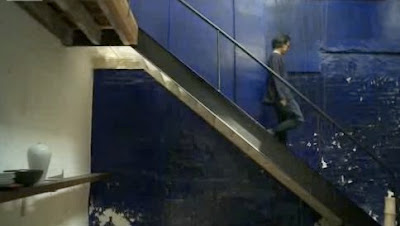


David Ling has a house with a bed cantilevered over a waterfall. I, for my part, would tumble to the pool below if I had such a thing, but I love the deep blue color of the wall with the peeling paint.
Video at Dwell.com
Note the interesting eyeglass collection.


David Ling has a house with a bed cantilevered over a waterfall. I, for my part, would tumble to the pool below if I had such a thing, but I love the deep blue color of the wall with the peeling paint.
Video at Dwell.com
Note the interesting eyeglass collection.
Monday, June 23, 2008
The Seven Who Fled
One night in Mallorca, in November 1935, I had a wonderful dream. I stood in the middle of a desert and the mountains in the distance suddenly burst into flames, and then they hardened into a row of luminous pearls. I awoke in a fever of joy and stepped out on the veranda. The Bay of Alcudia was as black as the fur of a yak, and on the horizon seven fishing boats lay in the sea with their seven torches.
...
I haven't read this book for many long years but as I look back on it from what seems like an enormous distance, I see seven fishing boats with their torches floating on a sea which is black as the fur of a Tibetan yak.
--Frederic Prokosch, from the 1983 Introduction to The Seven Who Fled
(1937)
I'm reading this on the recommendation of Harlan Ellison in one of his interviews. Prokosch was apparently a hugely popular writer in the 1930's with at least two bestsellers, but is now almost completely forgotten. I'd certainly never heard of him before. The book is embedded with these sort of jewel-like decriptions of the landscape, coupled with set of characterizations that are pre-modern, in the sense that the characterizations we see in silent movies are pre-modern: where the heroine is beautiful and yet overly curvaceous, where the hero's long blond hair comes loose and hides his face when he runs awkwardly (to our eyes, guided by college athletics and ergonomic shoes). The people dislike each other for reasons that don't quite match up with their actions. Their character is described a little to closely by race or nationality. Distant lands are described in terms that are currently reserved for other planets. In short, certain things are described in a shorthand that can't be read any longer, while other things for which we, in 2008, don't need to say are spelled out explicitly. It is for that reason and in that spirit that the book should be read, and read slowly, as Michael Ondaatje's English Patient said of Kipling, because it was written slowly, by hand.
What had happened was this.
There had recently been, all over Sinkiang, considerable disturbances. General Ma's army had swept bloodthirstily through the desert; the Tungans were still waging a truculent guerilla warfare against the provincial government; the Soviet government in the north had sent down its agent to Urumchi and Kashgar to support the Governor's forces. The cities, the towns, the tent-sprinkled plains, all rustled with distrust and detestation.
One day the Amban at Kashgar, a timorous, sedentary man, had petulantly issued orders that all Europeans leave the city. Meaning by that, of course, all Europeans whose motives appeared to him uncertain or unfamiliar. The officials made inquiries; the soldiers behaved impudently; the Amban wearily explained that orders from the Governor at Urumchi had to be obeyed. The atmosphere in the city grew hostile, full of glances, full of suspicious little whispers.
And so early one morning seven Europeans gathered at the il-smelling serai outside the poplar-lined walls of the old city and joined a small caravan that was starting eastward on a long journey toward Aqsu...
And what follows is the story of the disasters that befall them, singly or in pairs.
Sunday, June 22, 2008
Friday night, walk over to Michael & Kirk's. The Californians are in from San Clemente, and we order pizza--$44 for two mediums seems awfully steep, no matter how many toppings are on them. Kirk makes us watch Kathy Griffin, so now I'm naturally addicted; previews of that real estate show with the OCD guy who worries about the temperature and exact composition of his Starbuck's mean I've got to watch that one too. Everybody tired from a late night the night before, or maybe tomorrow.
Saturday, do nothing around the house in anticipation of Ed the Fox News Outlet's party, except shave my beard into a pornstache. Ride out there with Eric & Liza and Mark the Shark. Eric shouts at people whose cars have broken down in the middle lane, thus stopping traffic for six miles. Trip out to Iowa takes two hours or more. We stop at the Oasis and I get a 64oz Diet Coke for $0.99. All the sizes are the same price. Weird. So I drink my lake of Coke slowly over the course of the evening and so cannot sleep on the two hour ride back. For some reason they've decided it would be an opportune time to shut Southbound 90 down to one lane for the evening, resulting in a 2AM return time. Ed & Gina produce a nutrition-free buffet on purpose; Gina regales us with stories about living in Alabama, where she was the only dinosaur-loving atheist in Church school. As a result, she ended up going to the swimming pool a lot that summer. Patrick gets the lead role in American Theater Company's production of Hedwig, and we all promise to go. He and Joshua wear coordinated red, white & blue vests for the evening. Joshua tells stories about working in the Rock & Roll show at Six Flags Louisville, where he got a taste of being famous for the twelve people who would show up on a regular basis with his name written on posters, bodyparts &c.
Today, I wake up too late for yoga again, and watch Lindsay Graham knock the stuffing out of Joe Biden on Meet the Press for no good reason. I notice a bunch of restaurants lately with "we don't think we have Salmonella-bearing tomatoes" disclaimers on the doors.
Friday, June 20, 2008
A Polaroid a Day
Jamie Livingston took a Polaroid a day every day from March 31st 1979 until the day he died. 6,697 of them. Mental Floss has the story.
Boom

Lunch at a neighborhood cafe. Cheesesteak that's a little too dry served by a waitstaff that's a couple of people short.
That night I head out to see a band called Mucco Pazza at the Stan Mansion on Kedzie with Ed, Gina, Mark the Shark and a bunch of Gina's friends. A lot of interesting fashion choices and incomplete haircuts in the room. The band is a punk marching band with gypsy swing and early 20th c. classical influences (references to Shostakovich and Bartok, cheerleaders who chant about number theory). About 30 people on stage, when they're not playing from within the audience or on a balcony at the back or trumpeting out of the proscenium arch. A lot of short people keep pushing in front of me, and tall guys push in behind. Very loud, very hot.
That night I head out to see a band called Mucco Pazza at the Stan Mansion on Kedzie with Ed, Gina, Mark the Shark and a bunch of Gina's friends. A lot of interesting fashion choices and incomplete haircuts in the room. The band is a punk marching band with gypsy swing and early 20th c. classical influences (references to Shostakovich and Bartok, cheerleaders who chant about number theory). About 30 people on stage, when they're not playing from within the audience or on a balcony at the back or trumpeting out of the proscenium arch. A lot of short people keep pushing in front of me, and tall guys push in behind. Very loud, very hot.
Tuesday, June 17, 2008


George Soros on the Bubbling Economy
George Soros holds forth in McLean's. He makes the extremely valid point that even a moderate contraction in the credit market could result in a large, sustained economic downturn, and that market fundamentalism hasn't done well by us lately (or ever).
Herr Doktor Professor Karl Popper also gets a guest reference, in a question on the interaction between freedom and empirical reality:
Behind the housing bubble, there’s a super bubble which has been growing for the last 25 years. Every bubble has an element of reality and an element of fantasy, of misinterpretation. The reality has been a trend of ever-increasing use of credit, of credit expansion. The misconception is that markets tend toward equilibrium and can be left to their own devices, to take care of their excesses. In the boom phase, it’s very pleasant because you enjoy credit creation and, with that, comes wealth creation. In the bust phase, it’s very unpleasant because you have credit contraction, a reduction of leverage, a decline in the value of collateral, etc. and that involves wealth destruction.
Herr Doktor Professor Karl Popper also gets a guest reference, in a question on the interaction between freedom and empirical reality:
Q: You argue that freedom of thought doesn’t mitigate the misconception problem—that is, that an open society can’t produce a perfect market. Does it actually do the opposite?
A: It’s a somewhat different issue. I discovered a misconception in my own ideal of open society, which I kind of took over from Karl Popper. We all took it for granted that the purpose of critical thinking is to improve our understanding of reality. That’s the cognitive function. Then there’s this manipulative function, which is to change reality to meet your own desires, to influence people in a way that they’ll follow you. Politics is dominated by the manipulative function. You can’t take it for granted that critical thinking will give you a better understanding of reality. What you took for granted, you have to introduce as a requirement. I’m not abandoning open society at all; I’m just taking another step in what is necessary to bring about a well-functioning open society.
America, because of the adversarial, competitive nature of the political and economic system has really lost sight of the importance of understanding reality.
Monday, June 16, 2008
Sunday, June 15, 2008
Saturday I wandered around the Old Town Art Fair(s) with Kirk, Karen and Kate. Too much sun, rather than too hot, resulting in the necessity of an extended afternoon nap. Read Full Circle in one sitting while listening to Joni Mitchell, who sounds like California and always will.
Sunday, up at 5AM to hear the wind howling past for half an hour, followed by a short burst of rain and cooler weather. Fall asleep on the couch and miss yoga. Long phone call with Mom & Dad for Father's Day.
Sunday, up at 5AM to hear the wind howling past for half an hour, followed by a short burst of rain and cooler weather. Fall asleep on the couch and miss yoga. Long phone call with Mom & Dad for Father's Day.
The Quotable Me
"The first child resembles the father, the second child resembles the mother, and the third child resembles me."
Friday, June 13, 2008
Writers Interview Roundup
William Gibson interviewed by io9.
And Gore Vidal in the Independent on family, feuds and fame.Douglas Coupland's descriptions of Vancouver circa City of Glass are closest to my sense of the place. It's hemmed in and separated from the rest of the world by an ocean, a border, mountains. And then there's the unknown and incomprehensible north. Vancouver sits there, insulated to some extent, but picking up influences from across the ocean and across the border. The signals seem to be amplified by those symbolic barriers. Psychogeographically, I identify with greater Vancouver more than I do with the rest of Canada, which I have a fondness for and good feelings for. Vancouver's peculiar culture feels like home.
I like it because I grew up in a really extreme monoculture in southwestern Virgina. I was surrounded by Southern white folks – this was in badass Appalachia, up in the hollers where my mother's family had been forever. Having that experience in a small town made me happiest in big cities. Especially in radically multicultural big cities – as far as you can get from monoculture. I'm happiest where people are generally not even of recognizable ethic derivations. I'm into hybrid vigor.
Canada is set up to run on steady immigration. It feels like a twenty first century country to me because it's not interested in power. It negotiates and does business. It gets along with other countries. The power part is very nineteenth century. 99 percent of ideology we have today is very nineteenth century. The twentieth century was about technology, and the nineteenth was ideology.
As a 10-year-old, Gore appeared in a Pathé newsreel, landing a light aircraft. How did that feel? "Great. I was the most famous kid in the United States. That was 1936." He points to a dresser covered with small framed photographs. "There's a picture of my father."
"He looks like a film star."
"He was like a film star. He was the most famous college athlete in the history of the United States. A quarterback at West Point. He won a silver medal in the Olympic Games of 1924. In the 43 years that I knew him, we never quarrelled once, and we never agreed on anything."His father's picture is towards the back of the display. Most prominently positioned is an image of a young woman with tousled hair, a mischievous grin, and great vitality: a tomboy with Katharine Hepburn cheekbones.
"Amelia Earhart," Vidal says.
"You can see courage in those eyes." "You can."
"Didn't she have a fling with your father?"
"She had more than that. I said to him, "Why didn't you marry her?' This was after she went down in the Pacific in 1936. They'd set up three airlines together." Even now, more than seven decades later, there is emotion in his voice. "He said: 'I have never really wanted to marry another boy.' And she was like a boy."
...He has recalled [his mother] telling him, for instance, that rage made her orgasmic ("I forgot to ask her if sex ever did") and remarking that she was born only "because my mother's douche bag broke". Nina also informed him how, on the way to their honeymoon, his father had told her: "'There's something very important I want you to know.' I was so excited. He's going to tell me he loves me. But he didn't. Instead, he said: 'I have three balls.'" According to Vidal, his father "was in all the medical books".
Sounding Rooms
 The always great BLDG BLOG has a series of posts on hidden rooms, including this one, discussing Allen Fea's book. Nice set of comments as well. Apparently, the dream of finding new rooms in one's house is a common one, particularly among city dwellers. Likewise, the theosophists used to say that this was one of the first signs that you were doing some astral travel while lucid dreaming, and that the extra spaces were the result of the psychic space being a mirror of the physical or vice versa.
I used to have dreams about finding "extra" rooms behind the registers, and "extra" roads, usually dirt roads, lined by trees and elaborate, looming houses which appeared between existing hedgerows near my house.
This was probabaly touched off in part due to the fact that there was an entire extra row of lots that ran behind one of my friends' houses, one of which contained the single spookiest house in the neighborhood. Made of nasty, rotted-looking brown wood, abandoned and half ruined, surounded by burnt out grass and weeds. We could just see into the property whilst perched in a crabapple tree at the edge of my friend's back yard, with the partial obscurity offered by the branches adding to the uncanny feeling, as if we were stalking the house through the savannah. We used to take turns telling each other hair-raising stories about the place (axe murderers, Amityville-style demonic possession, crazed drug-fiend cultists and bloodthirsty ghosts made star appearances). The object was to make someone completely freak out and lose their nerve for staring at the place.
After a few years, someone knocked the thing down and landscaped it into a backyard garden with azaleas and a water feature, completely oblivious to the fact that they were planting their ground cover on top of a gateway to HELL!!!
I think every neighborhood should be furnished with a derelict building vibrating with the uncanny for the purpose of edification and atmospheric enhancement for the young people.
Thursday, June 12, 2008
Dr. Chemex
I feel cheap and tawdry when I use links from boingboing or kottke, but sometimes they're too good to pass up, like this article from Gourmet Magazine on the inventor of the Chemex coffee maker.
“He loved to drink and he loved to eat,” says Roy Doty, a cartoonist who was a friend of the late inventor, “so going out for dinner with Dr. Schlumbohm was a horrifying experience.” Guests were treated to epic all-night food crawls in his huge Cadillac Coupe De Ville, which he pimped out with built-in shades and a solid-gold Chemex coffee maker bolted to the driver’s door. (When he traded in his car every two years, he removed the golden amulet and set it on the newer, larger model.) Like many German immigrants, Schlumbohm felt at home in Manhattan’s Yorkville neighborhood, once a stronghold of German restaurants and coffee shops. He drove his guests up into the 80s, handed anyone loitering near the area a ten-dollar bill to watch the car, and then marched in for his first course. Soon, they all piled back into the car and moved on to the next joint. “Eventually,” says Doty, “you’d be somewhere eating streusel with him and by that time it was two or three in the morning.” But three in the morning was nothing to Schlumbohm, who surrounded himself with fellow night owls and often made calls around that time to discuss his newest ideas.
When he did return home, it was, unsurprisingly, to a bachelor penthouse on 5th Avenue—a peeping Tom’s paradise overlooking Greenwich Village, with thousands of dollars worth of binoculars dangling from the windows, and ice buckets stocked with perpetually chilling German beers and wines at the front door for visitors. “He loved women, Dr. S., and women loved him,” says Doty.
Subscribe to:
Posts (Atom)